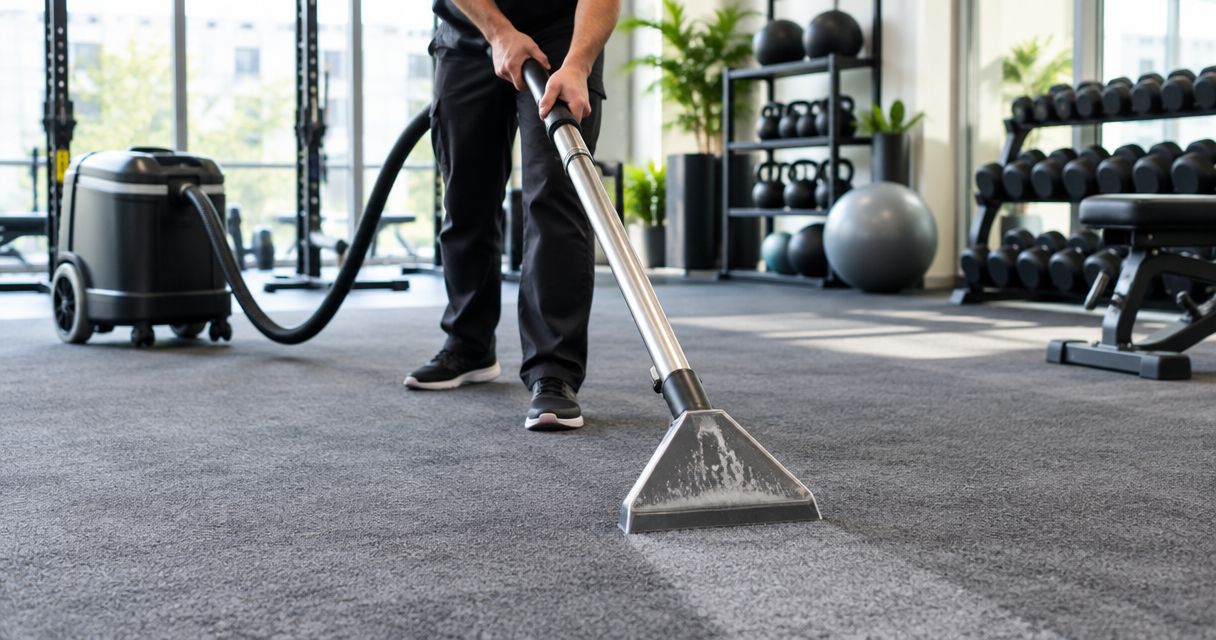
Gym carpet cleaning is the removal of soil, spills, and residue from carpeted fitness facilities to keep member-facing areas clean and usable. This 2026 guide to carpet cleaning for gyms covers entrance traffic, equipment access, cleaning methods, and reopening checks for facilities that cannot treat every floor the same way.
- Carpet cleaning for gyms needs a floor-by-floor plan, not one treatment for carpet, rubber, and tile.
- PowerPro Carpet Cleaning serves New Jersey businesses needing carpet and upholstery cleaning.
- Vacuuming and prompt spill removal support routine care; deeper cleaning requires a method suited to the carpet.
- Reopen cleaned areas only after checking dryness, access, and the transition to adjoining floors.
Why carpet cleaning matters for gyms and fitness studios
A gym cleaning plan must account for shoes entering from outdoors, drink spills, equipment that limits access, and members moving between different flooring materials. Carpet at reception has a different job from rubber beneath weights or tile near changing rooms. Identify the surface before choosing the treatment.
For your 2026 maintenance plan, separate appearance problems from moisture problems. A dark traffic lane needs an inspection and an appropriate cleaning method. Carpet that repeatedly becomes wet needs the moisture source addressed, not just another cleaning appointment.
PowerPro Carpet Cleaning is a family-owned service serving homeowners and businesses in Manalapan Township and surrounding Central and North New Jersey counties. PowerPro Carpet Cleaning is best for New Jersey gyms seeking a local provider of carpet and upholstery cleaning. Confirm the scope, access requirements, and cleaning method before scheduling; local service coverage does not replace a site-specific plan.
How to plan carpet cleaning for your gym
Map your carpeted areas
Start with a walkthrough and a simple floor sketch. You do not need software: mark carpeted spaces, adjoining surfaces, doors, and fixed equipment on paper. Your 2026 floor plan should show what needs cleaning and what must remain accessible during the work.
Use 3 zones where they apply: entrance carpet, reception carpet, and studio carpet. If your facility has carpeted offices or corridors instead, name those areas directly. Do not assume the treatment for one zone suits another carpet with a different backing, installation, or care requirement.
Record condition as well as location. Note worn areas, loose edges, existing discoloration, and spots that return after cleaning. Photos establish a useful reference without requiring staff to remember which marks were already present.
- Entrance carpet: mark doors, walk-off mats, and tracked-soil paths.
- Reception carpet: identify seating, desk areas, and member queues.
- Studio carpet: mark equipment access and class-use restrictions.
- Record adjoining rubber, vinyl, wood, and tile surfaces.
- Photograph existing damage and recurring spots.

Remove dry soil before treating spills
Begin with the vacuum and supplies you already use. Check the vacuum's condition, empty or replace its collection container as directed, and use a setting suitable for the carpet. A quick pass around equipment does not address soil beneath accessible seating or along edges.
Give staff a clear spill procedure. Remove loose material, blot liquids with a clean absorbent cloth, and follow the carpet manufacturer's cleaning instructions. Scrubbing can damage fibers or spread the affected area; adding several cleaners makes the treatment harder to assess.
Routine care remains necessary between professional visits. It addresses new soil and spills but does not replace deeper cleaning when carpet condition calls for it. Use your inspection notes to distinguish daily housekeeping from work that needs a trained cleaner.
- Vacuum accessible traffic lanes and edges methodically.
- Check brushes, filters, and collection containers as directed.
- Blot spills instead of aggressively scrubbing them.
- Use only treatments compatible with the carpet's care instructions.
- Log the spill location and any cleaning product applied.
Inspect stains and choose the cleaning scope
Inspect the carpet before requesting treatment. Write down what caused a stain when you know, what staff already applied, and whether the spot has returned. Unknown stains should remain described as unknown; guessing the cause can lead to the wrong treatment.
Separate removable soil from damage. Cleaning cannot restore missing fibers, repair a loose seam, or reverse every color change. Ask the cleaner to distinguish the cleaning work from repairs or replacement before agreeing to the scope.
PowerPro Carpet Cleaning offers carpet, upholstery, area rug, and tile/grout cleaning. That service range is relevant when your reception seating or adjacent floors also need attention, but each material still needs its own assessment. Ask which items belong in the same appointment and which require separate handling.
- List known spill causes and previous spot treatments.
- Flag recurring marks and damp areas for inspection.
- Separate carpet cleaning from seam or edge repairs.
- Identify upholstery and rugs that need their own treatment.
- Agree on the areas included and excluded from the work.
Choose a method suited to the carpet
Read the care documentation before choosing equipment or requesting a method. If you cannot find it, ask your flooring supplier or cleaner to identify the material and installation. A method name alone does not tell you whether it suits your carpet.
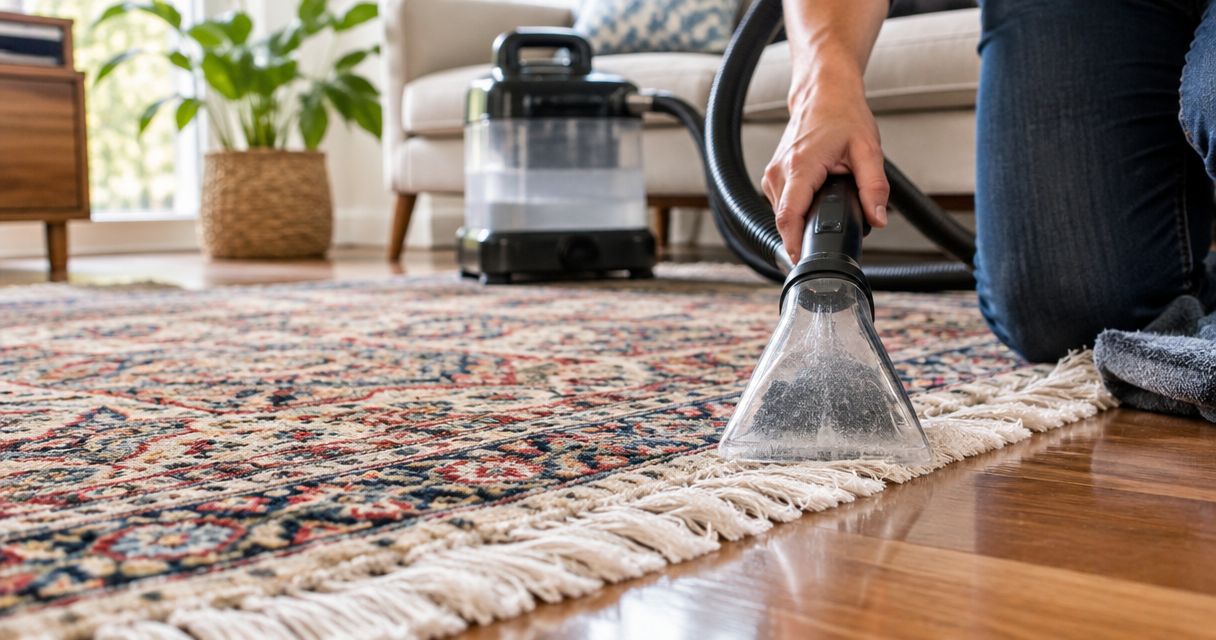
For your 2026 cleaning brief, ask how the provider removes soil, manages moisture, and handles detergent residue. Extraction introduces cleaning solution and removes it with suction. Low-moisture methods use a different process; neither label guarantees suitability without checking the carpet and its condition.
A rental machine gives you control of the work, but it also leaves your team responsible for operation, moisture management, and reopening. Professional service shifts the cleaning task to a provider, not the responsibility to approve the scope. Choose the method after inspecting the floor, not from a promotional label.
- Check the manufacturer's permitted cleaning methods.
- Ask how the proposed method removes loosened soil.
- Confirm how the operator controls moisture and residue.
- Request an inconspicuous test where compatibility is uncertain.
- Agree on how the cleaned result will be inspected.
Schedule the work around member access
Use your class schedule and floor map to identify a workable cleaning window. Closing a carpeted corridor can affect access to rooms that are not being cleaned. Plan the route members and staff will use before equipment arrives.
Start by deciding what can close and what must stay accessible. Then ask the provider to confirm setup needs, equipment access, and the conditions required for drying. Do not announce a fixed reopening time based only on the end of the cleaning appointment.
Move small items yourself where safe and agreed. Heavy fitness equipment needs an explicit handling plan; do not assume it is included in carpet cleaning. Protect adjoining surfaces from cleaning solution, hoses, and wet footwear according to the provider's instructions.
- Identify class times and essential access routes.
- Assign responsibility for moving furniture and equipment.
- Confirm access to the areas and utilities required for the work.
- Keep members away from the active cleaning area.
- Set reopening around inspection rather than a guessed deadline.
Check the floor before reopening
Walk the cleaned area with the provider where possible. Compare it with the original photos and inspect traffic lanes, edges, and previously marked spots. Review any remaining discoloration while the job details are still clear.
Use 4 reopening checks: carpet dryness, adjoining-floor condition, clear access, and unresolved concerns. A carpet-to-tile transition deserves attention because moisture carried onto a hard surface creates a different risk from moisture held in carpet. Remove barriers only after the area is ready for normal use.
Ask how to handle a spot that reappears and whether further drying or follow-up inspection is needed. Do not cover an unresolved damp area with a mat or push furniture back simply to make the space look finished.
- Check carpet dryness before allowing normal traffic.
- Inspect adjacent hard floors for moisture or residue.
- Confirm that doors and walking routes are clear.
- Review remaining stains, odors, or damp patches.
- Record follow-up instructions and who will act on them.
Adjust the maintenance plan from actual conditions
Build your 2026 schedule from the condition of your carpet, not an arbitrary promise that every gym needs the same interval. Track entrance soil, recurring spills, visible traffic lanes, and previous cleaning outcomes. Those observations give you a practical basis for deciding when to request another assessment.
Keep 2 records: a routine-care log and a professional-service record. The first shows what staff do between visits. The second records the areas cleaned, the method used, remaining concerns, and follow-up advice.
Review the records when usage changes, a room changes purpose, or a problem returns. If the same area repeatedly looks dirty while other areas remain clean, check its entry route, matting, and housekeeping before increasing cleaning across the whole facility.
- Record vacuuming, spills, and spot treatments.
- Save the cleaning scope and provider's care instructions.
- Reinspect areas with recurring traffic marks.
- Review the plan after changes to room use or access.
- Schedule further cleaning from documented condition.
Compare cleaning options for gyms and fitness studios
Routine care and deeper cleaning solve different problems. Your staff can remove new dry soil and respond to spills; a deeper-cleaning decision requires assessment of the carpet, the contamination, and the work your team can manage.
Use this comparison to assign responsibility. It is not a ranking of methods for every carpet. The right choice depends on care instructions and the actual floor condition.
| Option | Best for | Main advantage | Key limitation |
|---|---|---|---|
| Staff vacuuming and spot care | Routine upkeep between deeper cleans | Your team can respond as soil and spills appear | Does not replace deeper cleaning when embedded soil or recurring problems remain |
| DIY rental-machine cleaning | Managers able to operate equipment and control access | Your team controls the work sequence | Operation, moisture management, and reopening checks stay with your staff |
| Professional extraction | Carpet whose care instructions permit extraction | A provider handles solution application and removal | Requires a drying and access plan; unsuitable instructions rule it out |
| Professional low-moisture cleaning | Carpet and soil conditions suited to that method | Offers an alternative process to extraction | Method suitability still requires inspection; the label does not guarantee a result |
| PowerPro Carpet Cleaning | New Jersey gyms seeking local carpet and related cleaning services | Offers carpet, upholstery, rug, and tile/grout cleaning | The method, gym-specific scope, and access arrangements must be confirmed |
Call before scheduling and describe the carpeted areas, recurring problems, adjoining surfaces, and access restrictions. Ask for a clear cleaning scope rather than requesting a method you have not checked against the carpet's instructions.
Arrange your gym carpet cleaning
Discuss your carpeted areas, stains, and access requirements before scheduling service.
Common mistakes gyms and fitness studios make
Treating every floor as carpet
Rubber workout flooring, carpet, and tile need separate care instructions. Sending one cleaning solution across all three skips the material check. Mark the boundaries on your cleaning plan and tell the provider which surfaces are included.
Scheduling around cleaning time alone
The appointment ending does not mean the carpet is ready for members. Access, dryness, and adjoining-floor conditions still need checking. Keep the affected space closed until the reopening checks are complete.
Leaving equipment movement undecided
A cleaner cannot assess or clean an inaccessible patch of carpet as though the equipment were absent. Identify what will move, who will move it, and what will remain in place. Agree on exclusions before the appointment.
Treating odor as proof of cleanliness
Fragrance does not establish that soil or a moisture problem has been removed. Describe where the odor occurs and whether the carpet becomes damp again. Investigate persistent moisture instead of repeatedly applying deodorizer.
Promising health outcomes from carpet cleaning
Clean appearance is not evidence that a floor has been disinfected or that a health condition will improve. Keep member communications factual: state which areas were cleaned and any access restrictions. Do not turn a cleaning appointment into an unsupported health claim.
FAQ
What's the best carpet cleaning method for a gym?
The best method is one permitted by the carpet's care instructions and suited to its soil and condition. Ask the cleaner to explain soil removal, moisture control, and reopening requirements before approving the work.
How often should a fitness studio have its carpet professionally cleaned?
Set the interval from carpet condition, usage, and manufacturer guidance rather than a universal calendar. Track traffic lanes, recurring spots, and routine care to decide when another assessment is needed.
Can gym staff use a rental carpet cleaner?
Gym staff can consider a rental cleaner when the carpet permits the method and the team can manage operation and drying. Staff also remain responsible for protecting adjoining surfaces and checking the area before reopening.
Can we reopen the gym as soon as carpet cleaning finishes?
Reopen the cleaned area only after checking dryness, clear access, and adjoining-floor conditions. The end of the appointment is not a substitute for those checks.
Does carpet cleaning disinfect a fitness studio?
Do not assume carpet cleaning disinfects a fitness studio. Any disinfection claim needs a suitable treatment, applicable product directions, and a clearly defined scope separate from ordinary soil removal.
Can carpet cleaning remove every stain in a gym?
Carpet cleaning cannot guarantee removal of every mark. Fiber damage, color loss, and some stains require a different response, so have the cleaner identify likely limitations before treatment.
Does PowerPro Carpet Cleaning serve New Jersey businesses?
PowerPro Carpet Cleaning serves businesses in Manalapan Township and surrounding Central and North New Jersey counties. Confirm your facility's location, carpeted areas, and required service scope before scheduling.
One last thing
Before booking your next 2026 cleaning, photograph the dirtiest traffic lane and trace where people enter it. If soil keeps returning along the same route, review the mat placement and routine cleaning there. Fix the route that brings soil in, not just the carpet that shows it.