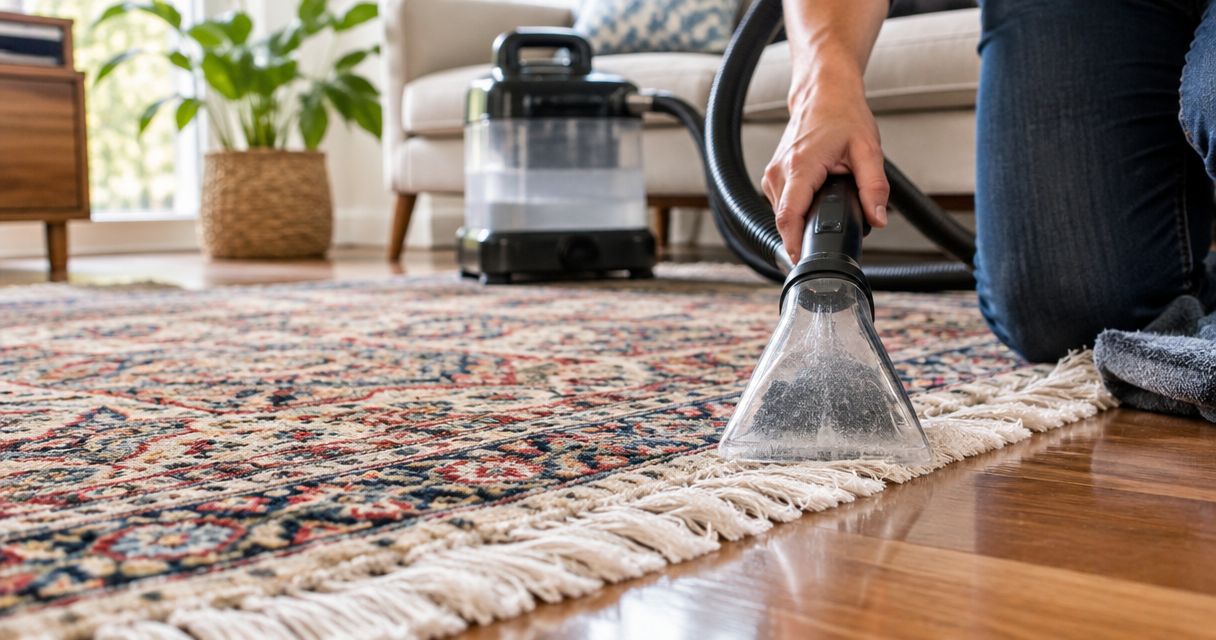
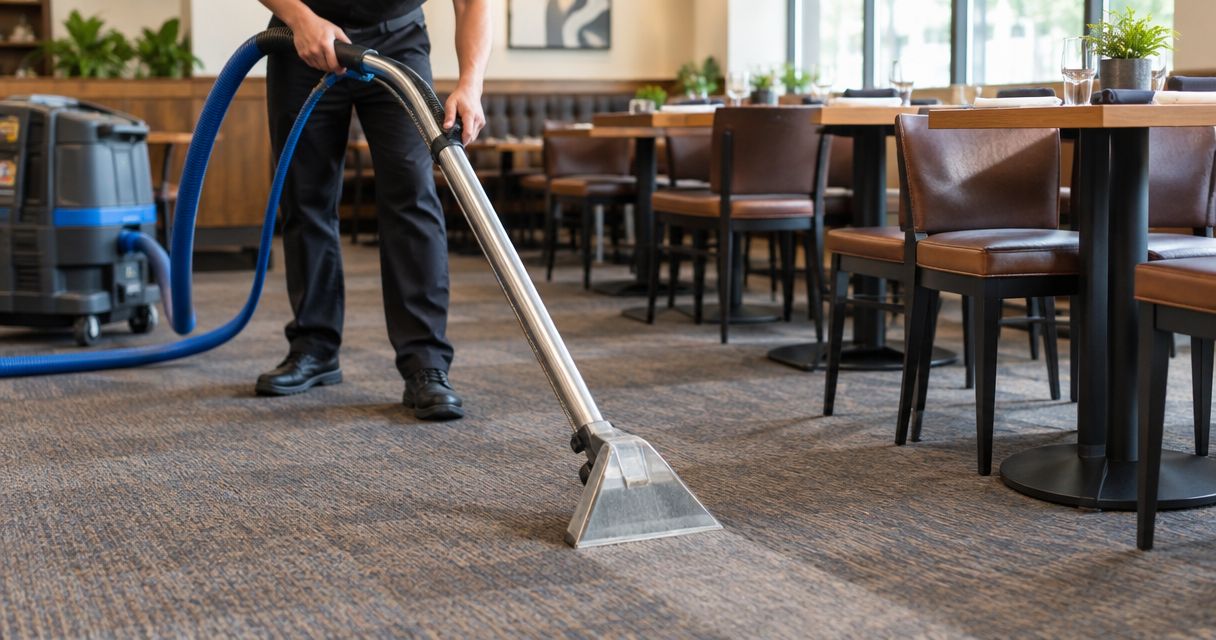
Restaurant carpet cleaning is the removal of dry soil, food spills, grease residue, and embedded dirt with the aim of keeping dining areas clean and usable between services. Your plan must account for table layouts, repeated spills, and reopening—not just whether the carpet looks better when the cleaner leaves.
- Carpet cleaning for restaurants needs daily soil removal, prompt spill treatment, and a cleaning window that protects reopening.
- PowerPro Carpet Cleaning serves businesses in Manalapan Township and surrounding Central and North New Jersey counties.
- Choose commercial carpet cleaning by carpet requirements and drying conditions, not by the strongest-sounding method.
- Inspect dining areas, entry routes, and service transitions separately; each needs a different maintenance priority.
Why carpet cleaning matters for restaurants
Restaurant carpet receives more than foot traffic. Food falls beneath tables, drinks spill around chairs, and footwear carries soil between entrances, dining rooms, and service areas. Treating all those problems with the same spray leaves you without a clear maintenance plan.
For your 2026 cleaning plan, separate daily housekeeping from periodic professional work. Vacuuming removes loose soil; it does not replace treatment of embedded dirt or oily residue. Professional cleaning does not replace the next shift's spill response, either.
PowerPro Carpet Cleaning is a family-owned service serving homeowners and businesses in Manalapan Township and surrounding Central and North New Jersey counties. The company offers carpet, upholstery, area rug, and tile/grout cleaning, which matters when your dining room contains several different surfaces.
Judge restaurant carpet cleaning by the condition of the carpet at reopening—not by how wet or freshly scented it feels afterward. A usable result includes addressed spills, identified permanent damage, and a floor ready for the traffic you intend to put on it.
Build your restaurant carpet cleaning plan for 2026
Map your carpet into separate cleaning zones
Start with a floor sketch and your own closing staff. Mark where guests enter, where servers carry food, and where spills repeatedly happen. You do not need software to identify the routes that receive the most attention.
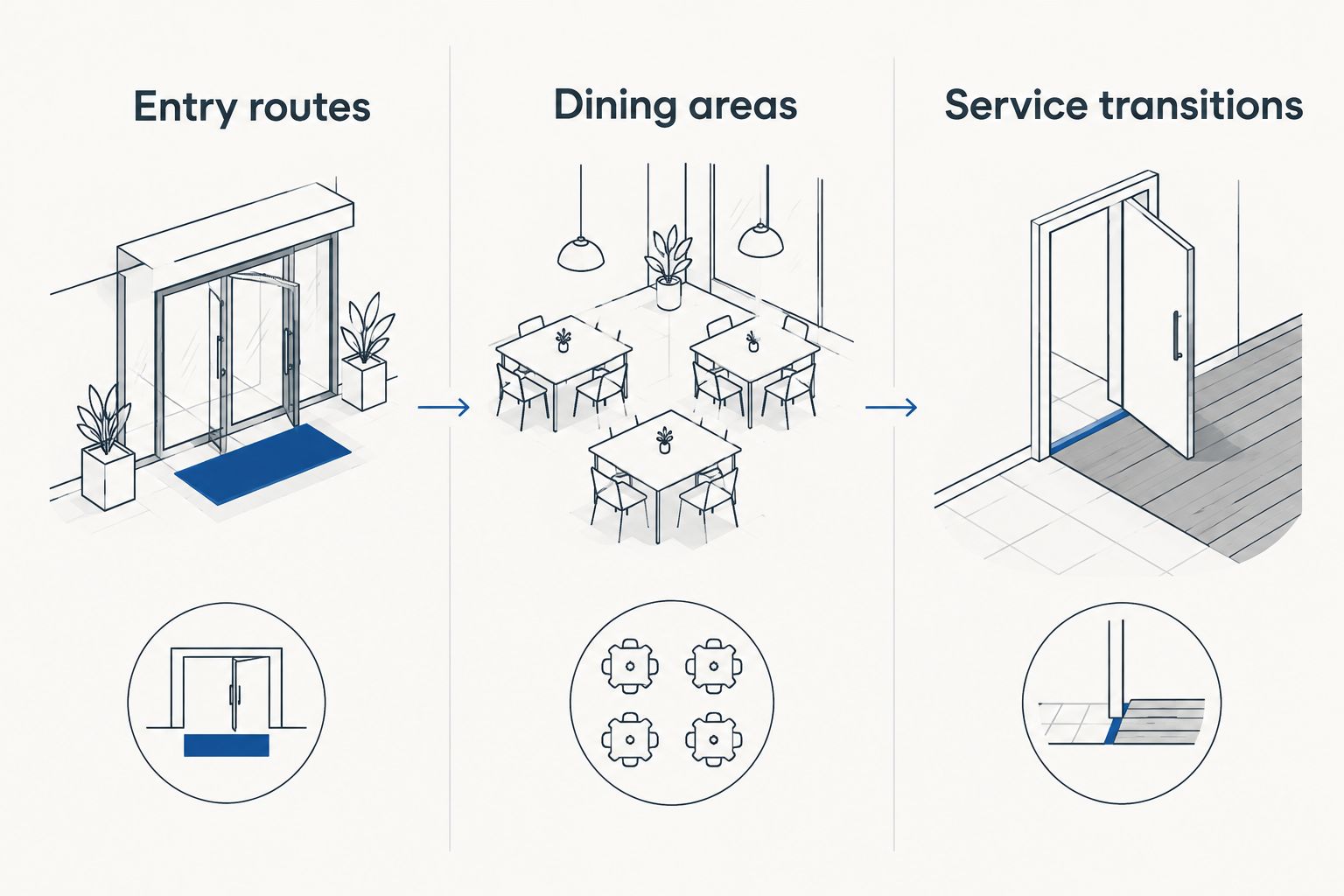
Use 3 cleaning zones as a starting framework: entry routes, dining areas, and service transitions. Separate private rooms or carpeted stairs when they need different access arrangements. The purpose is to make cleaning instructions match the actual floor, not to create paperwork.
A dark path beside a service station deserves investigation before another general cleaning. Check whether nearby footwear, food handling, or a hard-floor transition keeps transferring soil onto the carpet. Removing the visible mark without addressing its source leaves the maintenance problem unchanged.
- Entry routes: inspect tracked-in soil and the condition of entrance mats.
- Dining areas: check beneath tables, chair legs, and booth edges.
- Service transitions: identify residue carried from adjacent work areas.
- Restricted areas: mark furniture, cables, and spaces requiring manager access.
Establish a daily dry-soil and spill routine
Begin with the equipment and staff you already have. Follow the carpet manufacturer's maintenance instructions and check that the vacuum is working properly. A full collection container or obstructed brush makes a routine less useful, even when someone completes the checklist.
Move accessible chairs so staff can reach beneath tables. Inspect carpet edges and the routes around booths rather than vacuuming only the open center of the room. Keep equipment clean so it does not carry food residue from another area.
For spills, remove solids carefully and blot liquids instead of scrubbing aggressively. Use only a treatment compatible with the carpet and follow its directions. Test it in an inconspicuous area before broader use; an unfamiliar cleaner is not a shortcut.
Keep the task within staff competence. Unknown carpet fibers, recurring odors, and stains that resist approved treatment belong in the professional assessment—not in a cycle of stronger products.
- Vacuum accessible carpet before treating remaining marks.
- Remove food solids without grinding them into the pile.
- Blot liquid spills with a clean, absorbent cloth.
- Record the spill type and treatments already applied.
- Keep cleaning chemicals away from food and food-contact surfaces.
Choose professional help by the carpet and the problem
First, collect the carpet's care instructions and photograph the areas that concern you. Describe the problem plainly: sticky traffic lanes, drink stains, recurring marks, or soil beneath booths. Those details are more useful than asking for the most powerful cleaning available.
Professional service is the next step when routine maintenance does not address the condition or your staff cannot handle the scope. Ask how the cleaner will assess the carpet, choose a compatible method, and explain drying requirements. Do not assume every commercial carpet needs identical treatment.
PowerPro Carpet Cleaning is best for Central and North New Jersey businesses seeking a local carpet cleaning service. For a restaurant appointment, discuss the actual floor, access restrictions, and reopening requirements before booking.
The limitation is straightforward: a service description alone does not establish which method suits your carpet or whether a particular appointment fits your operating hours. Confirm both directly. Cleaning also cannot repair worn fibers or guarantee removal of permanent discoloration.
- Provide carpet care instructions when available.
- Identify food, drink, and oily-residue problems separately.
- Explain any previous cleaning or spot treatments.
- Ask what furniture must move and who moves it.
- Request clear instructions for drying and returning the area to use.
Schedule around drying and reopening
Build your 2026 schedule backward from the next service. Start with when staff need to arrange tables and when guests will enter—not simply when the cleaning appointment ends. Preparation and drying belong in the same plan.
Ask the cleaner what affects drying for the proposed method and your room. Carpet construction, moisture application, extraction, ventilation, and indoor conditions all matter. Do not promise your team a fixed reopening interval without instructions for that job.
Set 2 inspection checkpoints: one before cleaning and one before reopening. The first records existing stains, damage, and access issues. The second checks the condition of the cleaned area and whether it meets the cleaner's return-to-use instructions.
If the available window does not fit the work, change the scope or arrange a different closure. An appointment that forces you to reopen unsuitable carpet is not a workable schedule.
- Confirm the next guest-service start time.
- Allow for moving furniture and clearing access.
- Discuss ventilation and equipment placement with the cleaner.
- Keep unnecessary foot traffic off the work area.
- Inspect the carpet before resetting the dining room.
Prepare furniture and adjacent surfaces
Do the simple preparation yourself where it is safe: remove loose items, clear routes, and identify furniture that cannot move. Tell the cleaner about fixed booths, heavy tables, electrical connections, and fragile furnishings before the appointment.
Agree on the furniture arrangement rather than assuming everything will be moved. Carpet beneath a fixed booth presents a different access problem from an open dining aisle. A clear scope prevents disagreement about which areas were included.
Inspect adjoining hard floors and upholstered seating separately. Carpet cleaning, tile/grout cleaning, and upholstery cleaning are distinct tasks; they should not share a treatment merely because they occupy the same room. PowerPro Carpet Cleaning offers those service categories, so discuss each surface specifically when arranging work.
Assign 1 named shift manager to handle access and the final walk-through. That person should know what was agreed, which areas remain restricted, and what the reopening instructions require.
- Remove menus, bags, and loose floor-level items.
- Identify fixed booths and furniture that must remain in place.
- Separate carpet, tile/grout, and upholstery requirements.
- Agree on responsibility for furniture movement.
- Give the supervising manager the written job scope.
Measure the result and adjust the next clean
Use a simple inspection record before buying a reporting system. Take photographs from the same positions and record the carpet's condition after it is ready for use. Compare the same traffic lanes, table areas, and transitions rather than different parts of the room.
Distinguish remaining soil from permanent wear. Flattened pile, damaged fibers, and discoloration are not automatically evidence of an incomplete clean. Ask the cleaner to explain remaining marks so your next decision addresses the right problem.
For the remainder of 2026, adjust maintenance according to what you observe. Repeated spills call for better response procedures; recurring entry soil calls for attention to mats and vacuuming. A calendar reminder alone cannot tell you whether those routines are working.
Keep records short enough that staff will use them. The useful information is what happened, where it happened, and what action followed.
- Photograph the same marked areas before and after cleaning.
- Record unresolved spots and the cleaner's explanation.
- Check for recurring marks after normal restaurant use resumes.
- Review entrance mats and spill handling when problems repeat.
- Update the next cleaning scope from observed conditions.
Compare restaurant carpet cleaning options
The best option matches the task: daily maintenance for loose soil and fresh spills, professional assessment for embedded dirt and difficult conditions. None replaces the others in every situation.
Use this comparison when deciding how to divide the work. Ask for carpet-specific advice before selecting a wet-cleaning method, and treat equipment instructions as requirements rather than suggestions.
| Option | Best for | Main advantage | Key limitation |
|---|---|---|---|
| Staff vacuuming and approved spot treatment | Daily loose soil and fresh spills | Keeps routine care close to the problem | Does not replace periodic cleaning of embedded soil |
| DIY rental extraction | Manageable areas with compatible carpet and trained staff | Gives you direct control over the work | Your team handles preparation, technique, moisture removal, and drying |
| Professional hot-water extraction | Carpets approved for extraction with embedded soil | Combines applied cleaning solution with extraction | Requires a suitable drying and reopening plan |
| Professional low-moisture cleaning | Compatible carpets with maintenance needs suited to the method | Uses less applied moisture than wet extraction | Suitability depends on the carpet, residue, and cleaning objective |
| Carpet replacement assessment | Worn, damaged, or permanently discolored areas | Addresses material that cleaning cannot restore | Does not replace maintenance of the remaining carpet |
Do not choose between methods by name alone. Ask what problem the proposed method addresses, what its limitations are, and how the result will be inspected. For your 2026 plan, those answers matter more than a general claim that one method is always best.
Common mistakes restaurant operators make
Cleaning only the visible dining aisles
Open aisles are easy to reach, but dropped food and spills also collect beneath tables and around booth edges. Write access limitations into the scope so staff and cleaners know what needs movement and what remains inaccessible.
Treating every spot as the same spill
A drink spill, oily residue, and permanent discoloration are different problems. Record what caused the mark when known, and tell the cleaner which products staff used. Repeatedly adding cleaner without identifying the problem complicates the assessment.
Booking cleaning without a reopening plan
An after-closing appointment is not enough by itself. Furniture preparation, drying conditions, and the next service must fit together. Confirm the return-to-use instructions before committing the dining room to guests.
Expecting carpet cleaning to fix adjacent surfaces
Dirty grout, stained booth upholstery, and carpet soil need separate assessment. Define each requested service and its boundaries. A clean carpet will not resolve residue on the tile beside it or staining on the seating above it.
Using appearance as proof of sanitation
A better-looking carpet is not proof that a specific sanitizing or disinfecting result was achieved. Ask what the service actually includes. Keep restaurant food-safety procedures separate from claims about general carpet cleaning.
Arrange a restaurant cleaning assessment
Call PowerPro Carpet Cleaning to discuss your location, carpeted areas, furniture access, and opening schedule. Ask which cleaning approach fits the carpet and what preparation your staff must complete. Confirm the scope before booking.
Discuss your restaurant carpet cleaning
Review carpet condition, furniture access, and reopening requirements before arranging service.
FAQ
What's the best carpet cleaning for restaurants?
The best carpet cleaning for restaurants matches the carpet's care requirements, the soil present, and the available reopening window. Use daily vacuuming and approved spill treatment alongside professional cleaning when the condition requires it.
How often should a restaurant have its carpets professionally cleaned?
Set the professional cleaning schedule from observed soil, spill patterns, carpet instructions, and operating conditions. Inspect dining areas, entry routes, and service transitions separately rather than applying an unsupported interval to the entire restaurant.
Can restaurant staff clean carpet without hiring a professional?
Restaurant staff can handle routine vacuuming and approved spot treatment within their training. Embedded dirt, unknown carpet materials, recurring marks, and difficult residue need assessment before staff attempt broader treatment.
Is hot-water extraction better than low-moisture cleaning for restaurants?
Neither method is best for every restaurant carpet. Choose according to carpet compatibility, the cleaning objective, and drying requirements, and ask the cleaner to explain the proposed method's limitations.
Can carpet cleaning remove every food or drink stain?
Carpet cleaning cannot guarantee removal of every food or drink stain. Results depend on the material, the spill, previous treatments, and whether permanent discoloration or damage has occurred.
Can a restaurant reopen immediately after carpet cleaning?
Reopen the cleaned area only when it meets the cleaner's return-to-use instructions. Plan for drying, furniture placement, and a final inspection rather than assuming the appointment's end marks the reopening time.
Does carpet cleaning also clean restaurant booths and tile floors?
Carpet cleaning does not automatically include booth upholstery or tile floors. Request those surfaces separately and confirm their cleaning requirements and scope before booking.
What should I tell a carpet cleaner before booking restaurant service?
Describe the carpeted areas, recurring spills, previous treatments, furniture restrictions, and next opening time. Provide carpet care instructions when available and agree on preparation, access, and the final inspection.
One last thing
Before adding another cleaning appointment to your 2026 calendar, inspect where the dirty route begins. If soil repeatedly enters from the same doorway or service transition, fix that maintenance gap alongside the carpet cleaning. Treat the source and the carpet together.