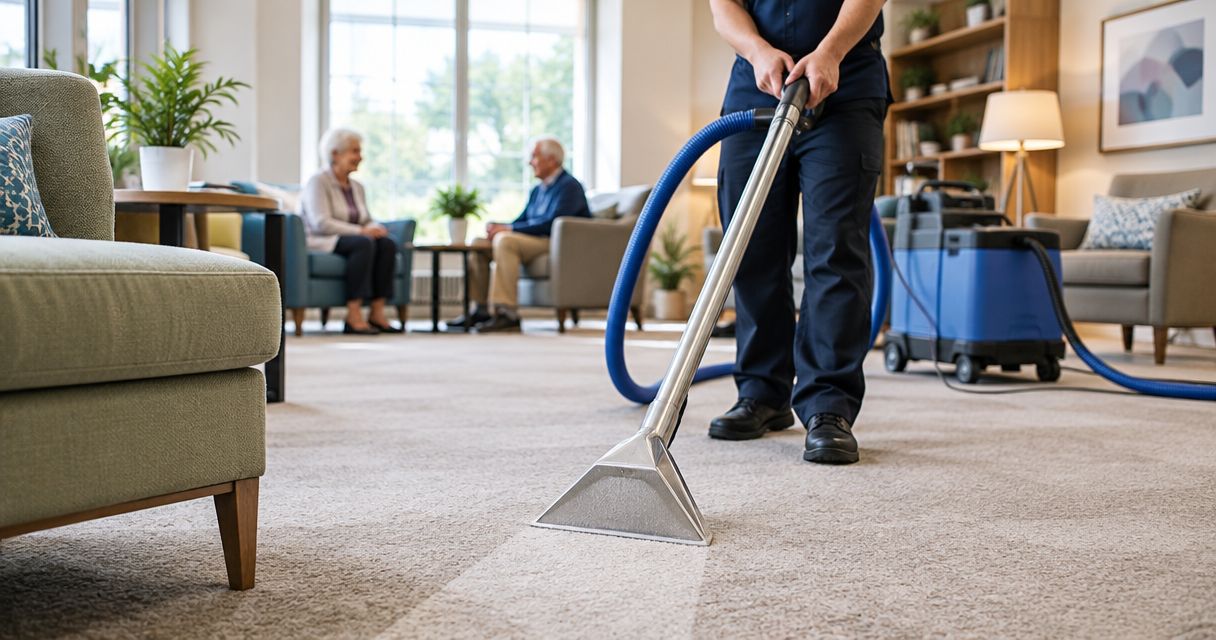
Senior living facilities’ carpet cleaning is planned soil removal with the aim of keeping resident rooms and shared areas clean without disrupting care or access. This guide to carpet cleaning for senior living facilities covers method selection, resident communication, drying checks, and contractor questions for your 2026 maintenance plan.
- Carpet cleaning for senior living facilities needs controlled access, material checks, and a clear reopening decision.
- PowerPro Carpet Cleaning is a local option for carpet and upholstery cleaning inquiries in Central and North New Jersey.
- Use routine vacuuming for loose soil; select deeper cleaning according to carpet instructions and facility needs.
- Keep residents off damp carpet and maintain an accessible alternative route until the area is ready.
Why carpet cleaning matters for senior living facilities
A senior living facility cannot treat every room as an empty office. Residents use corridors, dining areas, lounges, and bedrooms throughout the day. Cleaning plans must account for mobility aids, staff assistance, meal schedules, and access to essential rooms.
The practical problem is not just removing a stain. It is removing soil while keeping equipment, cords, damp surfaces, and temporary barriers out of residents’ travel routes. A clean carpet does not make a room ready to reopen if the route through it remains obstructed.
For facilities in Manalapan Township and surrounding Central and North New Jersey counties, PowerPro Carpet Cleaning offers carpet, upholstery, area rug, tile/grout, and air duct cleaning services. Confirm the facility scope, chosen method, and access arrangements before scheduling work.
Your 2026 cleaning plan should separate routine housekeeping from specialist work and incidents that require the facility’s care or infection-control procedures. Carpet cleaning removes soil; do not treat an ordinary cleaning appointment as a medical disinfection program.
How to plan carpet cleaning around resident care
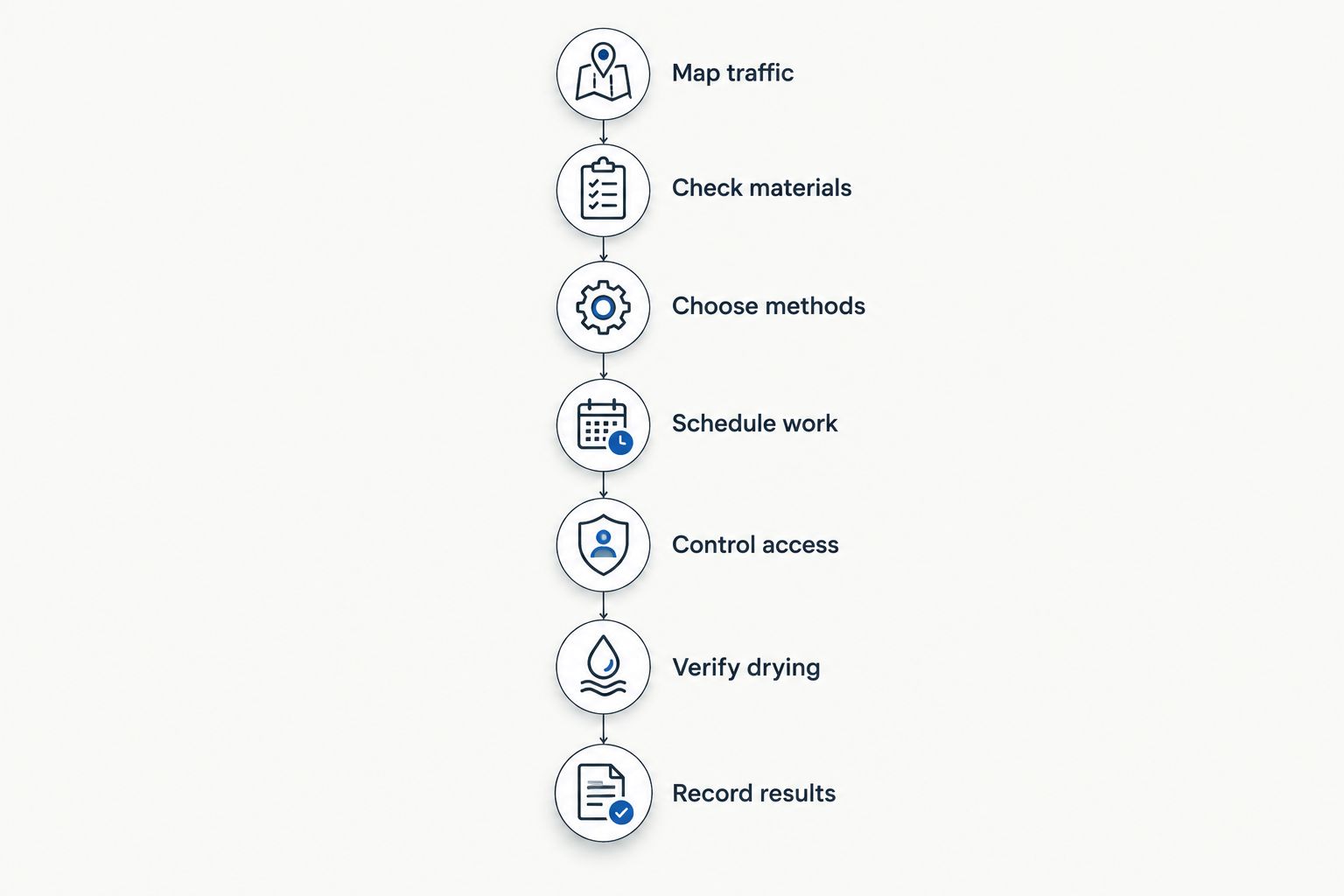
Use this sequence for each cleaning area: map traffic, check materials, choose methods, schedule work, control access, verify drying, and record results. Start with your own floor plan, carpet records, and housekeeping logs. A contractor helps carry out the cleaning; facility staff remain responsible for resident communication and care arrangements.
Map traffic
Walk the building with housekeeping and a staff member familiar with residents’ daily routines. Mark 3 zones on your floor plan: resident rooms, shared spaces, and connecting routes. These are planning categories, not a required cleaning frequency.
List where residents must travel even while work is underway. A corridor connecting bedrooms to a dining room needs a different plan from an unused meeting room. Note walkers, wheelchairs, room entrances, and places where staff assist residents with transfers.
Do not approve a cleaning zone until you have identified its alternative access route. If there is no suitable alternative, arrange a different work sequence rather than relying on a warning sign alone.
- Resident rooms: record occupied rooms and required staff coordination.
- Shared spaces: mark dining areas, lounges, and activity rooms.
- Connecting routes: identify essential corridors and exits.
- Note transition points between carpet and hard flooring.
Check materials
Use carpet labels, installation records, and manufacturer instructions before selecting a cleaning process. Identify the carpet construction and any restrictions on moisture, cleaning agents, or equipment. Treat attached carpet, loose area rugs, and upholstered seating as separate materials.
Inspect seams, loose edges, ripples, worn areas, and existing stains. Cleaning is not a repair for a lifted edge or damaged backing. Record these conditions so maintenance staff can address them and the cleaning team can avoid treating a defect as ordinary soil.
A hidden-area compatibility test helps check a selected treatment before wider use. It does not replace the manufacturer’s instructions or guarantee that every stain will respond the same way.
- Collect available carpet care instructions.
- Mark damaged seams, edges, and transitions.
- Identify loose rugs that need separate handling.
- Photograph existing stains and visible damage.
- Confirm treatment compatibility before broad application.
Choose methods
Begin with the work your housekeeping team can perform using existing equipment: remove loose debris, vacuum according to the carpet instructions, and respond to spills using approved procedures. Routine vacuuming and deeper cleaning serve different purposes; neither replaces the other.
For deeper soil removal, ask the contractor to explain the proposed method in plain language. Hot-water extraction uses water, cleaning solution, and recovery equipment. Low-moisture processes use less applied liquid, but their suitability still depends on the carpet and the cleaning task.
PowerPro Carpet Cleaning is best suited to a local carpet-cleaning inquiry from facilities in Manalapan Township and surrounding New Jersey counties. Ask about the proposed facility work rather than assuming a method, drying schedule, or infection-control capability from the service name.
- Separate routine vacuuming from restorative cleaning.
- Match the method to the carpet care instructions.
- Ask how loosened soil and solution are removed.
- Identify stains that require separate assessment.
- Discuss cleaning-agent information with the facility’s designated lead.
Schedule work
Create a work schedule around the actual use of each area. Ask staff about meals, medication rounds, visiting periods, activities, and resident rest. Do not assume overnight work is automatically less disruptive; noise and room access still matter.
Break the project into areas that can remain closed without cutting off essential routes. Agree on where the crew enters, parks equipment, obtains approved utility access, and removes recovered wastewater. Those arrangements should be settled before arrival.
Put the 2026 schedule in writing, including who authorizes the start and who decides whether an area can reopen. The cleaning appointment and the reopening decision are separate events.
- Confirm the rooms and corridors included in each visit.
- Name a staff contact for resident coordination.
- Notify affected residents and staff using accessible communication.
- Agree on equipment placement and service access.
- Plan around care activities and essential routes.
Control access
Use your facility’s approved barriers and signage to separate residents from active work. Keep hoses, cords, cleaning equipment, and supplies within the controlled area. Warning signs supplement physical access arrangements; they do not provide an alternative route.
Explain the temporary route to staff who help residents move around the building. Check that the route accommodates the mobility equipment actually in use. A detour through a narrow storage area is not a practical solution simply because it avoids damp carpet.
For spills involving bodily fluids or other contamination, follow the facility’s designated incident procedure. Do not send an ordinary cleaning crew into that work without confirming the required scope, protective measures, and responsibilities.
- Place barriers before equipment enters the work area.
- Keep exit access and essential travel routes clear.
- Route cords and hoses away from resident movement.
- Secure cleaning agents against unintended access.
- Assign responsibility for maintaining the controlled area.
Verify drying
Ask how the contractor will assess drying and what site conditions affect it. Carpet construction, applied moisture, recovery, ventilation, and room conditions influence the result. Do not use a fixed reopening promise as a substitute for checking the actual area.
Use 2 reopening checks: carpet condition and route readiness. These are an operational checklist, not a technical moisture standard. Follow manufacturer guidance and the contractor’s agreed assessment process for carpet condition; inspect barriers, equipment, and transitions for route readiness.
Check dampness at edges and other areas where moisture can remain. A surface that feels dry in one location does not establish that the whole area is ready. Keep drying equipment protected from residents and avoid creating a new obstruction.
- Confirm the agreed drying assessment has been completed.
- Inspect carpet edges and transitions before reopening.
- Remove equipment and temporary trip hazards.
- Check the alternative route before withdrawing barriers.
- Record who approved the area for use.
Record results
Keep 1 cleaning log for each completed area. Record the date, room or zone, method, observations, unresolved stains, and reopening approval. This gives your 2026 maintenance plan a record rather than a calendar full of appointments with no outcome attached.
Use those observations to adjust future work. Repeated soil near an entrance calls for reviewing tracked-in dirt and routine housekeeping. A recurring spot needs investigation before repeated treatment; the visible mark alone does not identify its cause.
Review the carpet and nearby upholstery separately. Cleaning a corridor does not address a stained lounge chair, and cleaning a chair does not resolve damaged flooring beneath it.
- Record the area, date, method, and responsible staff member.
- Note stains or damage that remain after cleaning.
- Document drying assessment and reopening approval.
- Track repeat problem locations across visits.
- Assign repairs and follow-up work to the appropriate team.
Compare cleaning options for your facility
Choose each option by the job it performs, not by its name alone. Routine maintenance, spot treatment, and deeper cleaning belong in the same plan, but they are not interchangeable. For your 2026 review, compare material compatibility, staff workload, soil removal, and access restrictions.
| Option | Best for | Practical advantage | Key limitation |
|---|---|---|---|
| Routine vacuuming | Day-to-day removal of loose soil | Fits regular housekeeping work | Does not replace treatment of embedded soil or stains |
| Targeted spot treatment | A localized spill or mark | Limits treatment to the affected area | The wrong agent or technique can damage the carpet |
| In-house extraction | Facilities with suitable equipment and trained staff | Gives staff direct control over scheduling | Requires recovery, drying, equipment care, and access management |
| Professional hot-water extraction | Deeper cleaning where carpet instructions permit it | Applies solution and recovers loosened soil | Adds moisture and requires controlled drying and reopening |
| Professional low-moisture cleaning | Maintenance where the selected process suits the carpet | Uses less applied liquid than extraction processes | Suitability and soil removal depend on the specific process |
Choose the method after checking the carpet, not before. Ask any contractor to explain what the selected process will address, what it will leave unresolved, and how the work affects resident access.
Common mistakes senior living facilities make
Cleaning an entire corridor without an access plan
Closing the full route between resident rooms and essential spaces creates a care problem before cleaning begins. Divide the work into manageable zones or arrange an approved alternative route. Make sure staff understand the sequence, not just the appointment time.
Reopening because the appointment has ended
A crew’s departure does not establish that the carpet is dry or the area is ready. Use the agreed carpet-condition and route-readiness checks. Keep responsibility for reopening with the designated facility contact.
Treating every stain as ordinary housekeeping
Food, tracked-in dirt, and contamination incidents require different decisions. Use routine procedures for routine soil and the facility’s incident process for contamination. Do not make a disinfecting claim based solely on stain removal or a fresh smell.
Promising residents that every mark will disappear
Some visible marks reflect wear, dye change, or other damage rather than removable soil. Record the condition and ask for an assessment before setting expectations. A cleaning visit cannot replace carpet repair or replacement when either is needed.
Choosing a contractor without agreeing on responsibilities
An unclear scope leaves staff and contractors making decisions at the door. Confirm room access, furniture handling, material checks, barriers, drying assessment, and follow-up responsibilities in writing. Ask how changes to the agreed work will be communicated.
FAQ
How often should a senior living facility clean its carpets?
Set the cleaning schedule from carpet instructions, traffic, soil observations, and facility procedures rather than using one interval for every room. Review resident rooms, shared spaces, and connecting corridors separately.
What is the best carpet cleaning method for senior living facilities?
The best method is the one that matches the carpet instructions, soil condition, and facility access plan. Ask the contractor to explain the proposed process, recovery, and drying assessment before approval.
Can residents stay in the building during carpet cleaning?
Plan occupied-building work only where residents can remain outside controlled cleaning areas and retain essential access. Coordinate room use, mobility assistance, and temporary routes with facility staff before starting.
Is low-moisture cleaning better than hot-water extraction?
Neither method is automatically better for every senior living facility. Low-moisture cleaning uses less applied liquid, while extraction applies and recovers cleaning solution; select the process according to carpet instructions and the actual cleaning task.
Does carpet cleaning disinfect a resident room?
Do not treat ordinary carpet cleaning as a disinfection procedure. Follow the facility’s infection-control process and use an explicitly agreed scope when contamination or disinfection is involved.
When can residents walk on freshly cleaned carpet?
Reopen the area after the agreed carpet-condition assessment and route-readiness checks are complete. Do not use the end of the appointment or dryness at a single spot as the reopening decision.
What should we ask a carpet cleaning company before booking?
Ask about material compatibility, the cleaning method, equipment placement, resident access, drying assessment, and unresolved stains. Put the work scope and responsibility for reopening in writing.
Does PowerPro Carpet Cleaning serve New Jersey facilities?
PowerPro Carpet Cleaning serves homeowners and businesses in Manalapan Township and surrounding Central and North New Jersey counties. Call to confirm your facility location, work scope, and access requirements before scheduling.
One last thing
Make the final handover about access, not appearance. Before reopening, have the designated staff member walk the route a resident will actually use, including doorways and flooring transitions. Check it with the mobility equipment used in that area.
Call PowerPro Carpet Cleaning to discuss your 2026 facility cleaning plan. Have the floor plan, carpet instructions, affected areas, and access requirements ready so the conversation starts with the work you need.
Plan your facility carpet cleaning
Discuss your facility location, carpet areas, and resident access requirements.