Veterinary clinic tile and grout cleaning is the removal of soil from tiled floors and joints to support a clean, maintainable care environment. This 2026 guide separates routine cleaning, label-led disinfection, and professional deep cleaning because animal traffic, accidents, and treatment areas need different handling.
- Tile and grout cleaning for veterinary clinics starts with soil removal; disinfection follows the product label and clinic protocol.
- PowerPro Carpet Cleaning provides tile/grout cleaning for local businesses; veterinary infection-control decisions remain with the clinic.
- Separate floor zones, verify material compatibility, and keep animals away until the reopening conditions are met.
- Use professional deep cleaning for embedded soil, not as a substitute for daily cleaning or disinfection.
Why tile and grout cleaning matters for veterinary clinics
Veterinary floors collect hair, tracked-in dirt, food residue, and animal waste. Cleaning must address that soil without spreading it into examination rooms, treatment spaces, or isolation areas. A floor that looks clean is not proof that it has been disinfected.
Grout joints complicate the job because their texture and condition differ from the tile face. A mop that improves the appearance of tile does not necessarily remove embedded soil from the joints. Cracked grout also needs a maintenance decision, not simply more scrubbing.
For your 2026 floor-care plan, separate appearance problems from infection-control requirements. Assign routine cleaning to your staff, have the clinical lead approve disinfection procedures, and define where an outside cleaning service fits.
PowerPro Carpet Cleaning is a family-owned service serving homeowners and businesses in Manalapan Township and surrounding Central and North New Jersey counties. PowerPro Carpet Cleaning is best for local businesses seeking tile and grout cleaning, not veterinary infection-control advice.
Build a floor-care process your staff can follow
Start with a written routine using your existing floor records, approved products, and staff assignments. You do not need a new machine to identify the surface, remove loose soil, or separate cleaning tools by area.
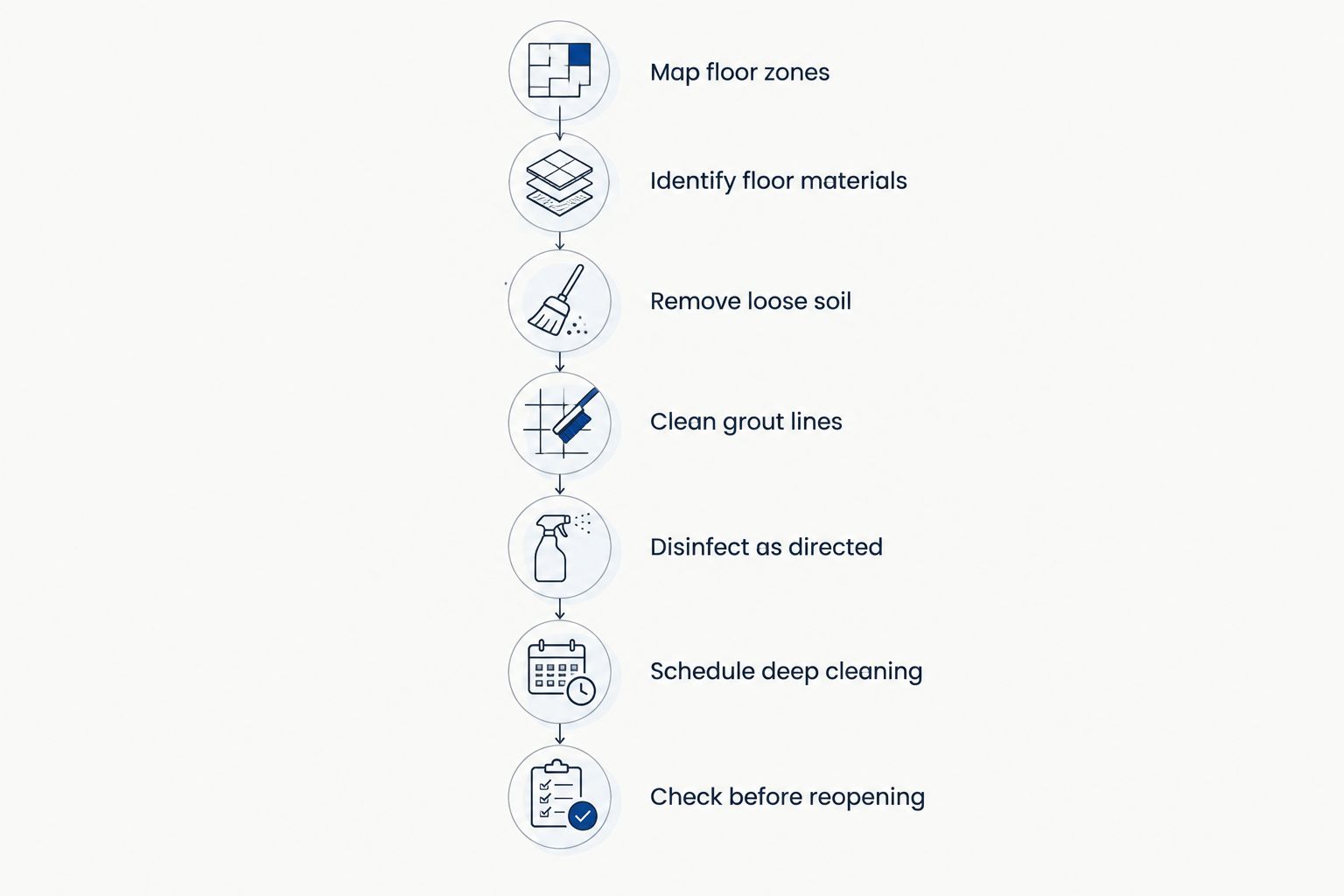
The following 7 steps give your clinic a practical sequence. Keep the procedure specific enough that a staff member can follow it without guessing which product, tool, or reopening rule applies.
Map floor zones
Draw a simple floor plan and mark where patients, staff, and cleaning equipment move. For an initial planning exercise, use 3 zone groups: public areas, general clinical areas, and restricted areas. Your clinical lead should refine those groups to match the clinic's actual infection-control needs.
Public-area cleaning cannot define the procedure for an isolation room. Identify any area where equipment, waste handling, or staff movement requires a separate routine. Keep the map with your 2026 cleaning instructions, not in an administrator's inbox.
- Mark reception, examination, treatment, kennel, and isolation spaces separately.
- Assign cleaning tools to the appropriate zones.
- Establish a cleaning order that avoids carrying soil into cleaner areas.
- Record who authorizes access to restricted rooms.
- Mark routes that must remain usable during cleaning.
Identify floor materials
Check installation records before selecting chemicals or equipment. Ceramic tile, porcelain tile, and natural stone do not share every cleaning requirement. Grout composition and any existing sealer also affect which treatment is appropriate.
Use the flooring manufacturer's care instructions as the starting point. If records are incomplete, ask a qualified flooring professional to identify the material before approving an aggressive treatment. Acidic products can damage acid-sensitive stone; stronger chemistry is not automatically a better choice.
- Record tile type, grout type, and known sealer details.
- Photograph cracks, missing grout, loose tiles, and damaged transitions.
- Check cleaner and disinfectant labels for surface compatibility.
- Test a proposed cleaning method on 1 inconspicuous area first.
- Refer structural damage to a repair professional rather than a cleaner.
Remove loose soil
Remove hair, grit, and other loose debris before wet cleaning. Use your clinic's approved collection method, particularly in areas with contamination concerns. Do not dry-brush contaminated material across a room or carry it through patient traffic.
For accidents, follow the clinic's waste-handling and protective-equipment procedure before cleaning the floor. Staff should know where supplies are stored and what requires escalation. A stain left after cleaning is a different problem from waste that has not been removed.
- Collect loose debris with tools approved for the area.
- Remove animal waste using the clinic's written procedure.
- Keep patients and unnecessary foot traffic outside the work area.
- Separate reusable tools from items designated for disposal.
- Clean or replace collection equipment before moving between zones.
Clean grout lines
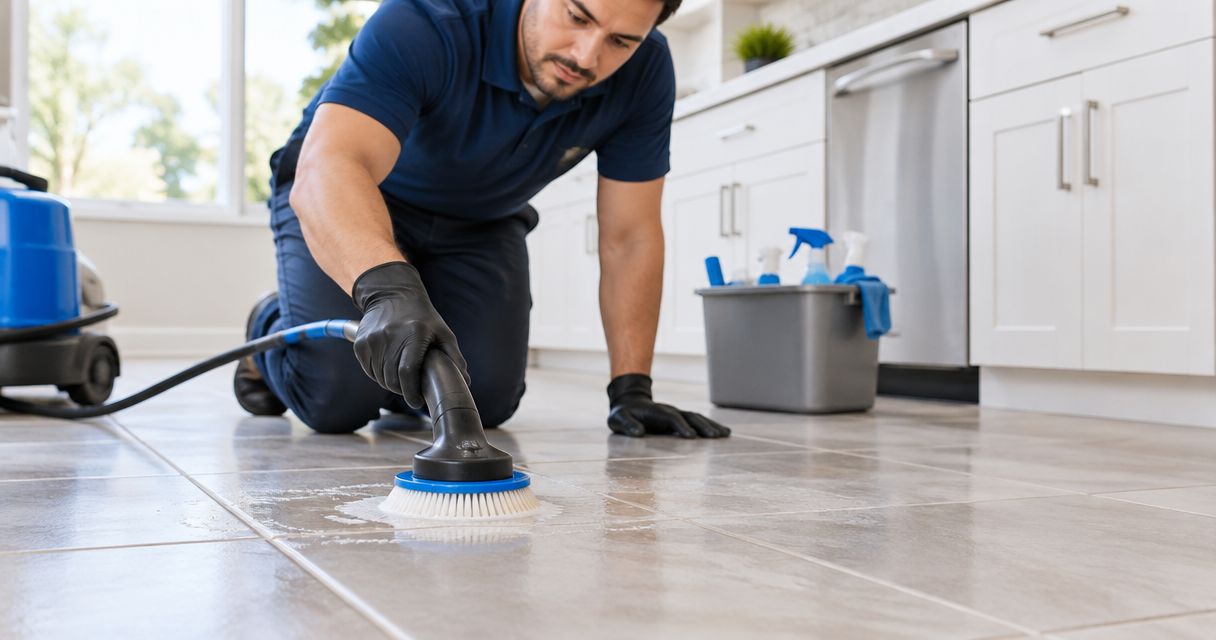
Start with a compatible cleaner and a manageable section of floor. Follow the product's dilution and application instructions, then use appropriate agitation to loosen soil from the grout. Remove the dirty solution instead of repeatedly moving it across adjacent tile.
A grout brush gives staff direct control over local buildup, but it adds labor on larger floors. Machine cleaning introduces equipment choices, access requirements, and recovery procedures. Choose a method for the surface and the soil, not for the strongest advertised chemical.
Do not judge success by color alone. Some grout discoloration remains after soil removal, and damaged joints need repair. Repeatedly treating the same dark patch without diagnosing it wastes staff time and risks surface damage.
- Follow the cleaner's stated dilution rather than adding extra concentrate.
- Use a brush or pad compatible with the tile and grout.
- Recover dirty solution using the approved method.
- Rinse when the product instructions require it.
- Inspect joints and edges before repeating treatment.
Disinfect as directed
Cleaning removes soil; disinfection is a separate process used to inactivate specified microorganisms. Where disinfection is required, select an EPA-registered product whose label covers the intended use, surface, and relevant organism claims. Your clinical lead owns that decision.
Follow the label's contact time and application conditions. When the label requires a surface to remain wet, wiping it dry early interrupts that procedure. Follow any stated rinsing, ventilation, protective-equipment, and animal-access instructions as well.
Keep 2 records if that makes responsibilities clearer: a cleaning log and a disinfection log. These records document completion, not proof that a surface is sterile. Never mix cleaning chemicals unless the product instructions explicitly permit it.
- Obtain clinical approval for the disinfectant and intended use.
- Clean first according to the product and clinic instructions.
- Measure dilution exactly as the label directs.
- Maintain the required contact conditions throughout the stated time.
- Follow rinsing and re-entry requirements before returning animals.
Schedule deep cleaning
Use staff observations to decide when routine cleaning needs professional support. Persistent grout buildup, dirty edges, and repeated soil residue are useful discussion points. Do not create a fixed service interval without considering the floor's condition, traffic, and existing routine.
For your 2026 service brief, describe the rooms, materials, access restrictions, and problem areas. PowerPro Carpet Cleaning provides tile/grout cleaning for businesses, but your clinic must agree on the scope before assigning work in treatment or restricted areas. Ask how the proposed method fits your flooring and cleaning procedure.
Professional work moves the deep-cleaning task outside your staff's daily workload. Its limitation is equally important: an outside cleaning visit does not establish a veterinary disinfection protocol or repair damaged grout.
- Provide a room list and identify restricted spaces.
- Share flooring records and the clinic's approved chemical restrictions.
- Ask about agitation, solution recovery, and any rinse requirements.
- Agree on who moves equipment and controls animal access.
- Confirm reopening conditions rather than assuming a drying time.
Check before reopening
Inspect the completed area before animals, clients, or staff return. Check for visible debris, leftover solution, slippery residue, and unresolved damage. Confirm that the applicable product instructions and clinic procedure have been completed.
A dry-looking floor is not the only reopening criterion. Required contact time, rinsing, ventilation, and animal-access instructions still apply. Have a named person approve the room instead of leaving that decision to whoever removes the warning sign.
- Inspect grout lines, corners, thresholds, and equipment edges.
- Check that dirty solution and cleaning tools have been removed.
- Confirm completion of required disinfection and re-entry steps.
- Record remaining stains or damage separately from cleaning failures.
- Release the room through the clinic's designated decision-maker.
The sequence matters: identify the floor and remove soil before choosing the next treatment. Professional cleaning belongs within this process, not outside it.
Compare your clinic's cleaning options
Choose each option for a defined job. Routine cleaning, grout scrubbing, professional deep cleaning, and disinfection are not interchangeable services.
| Option | Best for | Main advantage | Key limitation |
|---|---|---|---|
| Staff-led routine cleaning | Daily soil removal and prompt accident response | Fits the clinic's own access and cleaning procedures | Does not necessarily remove embedded grout buildup |
| Manual grout scrubbing | Localized soil in accessible joints | Gives direct control over a small problem area | Labor-intensive across large floors; unsuitable tools can damage surfaces |
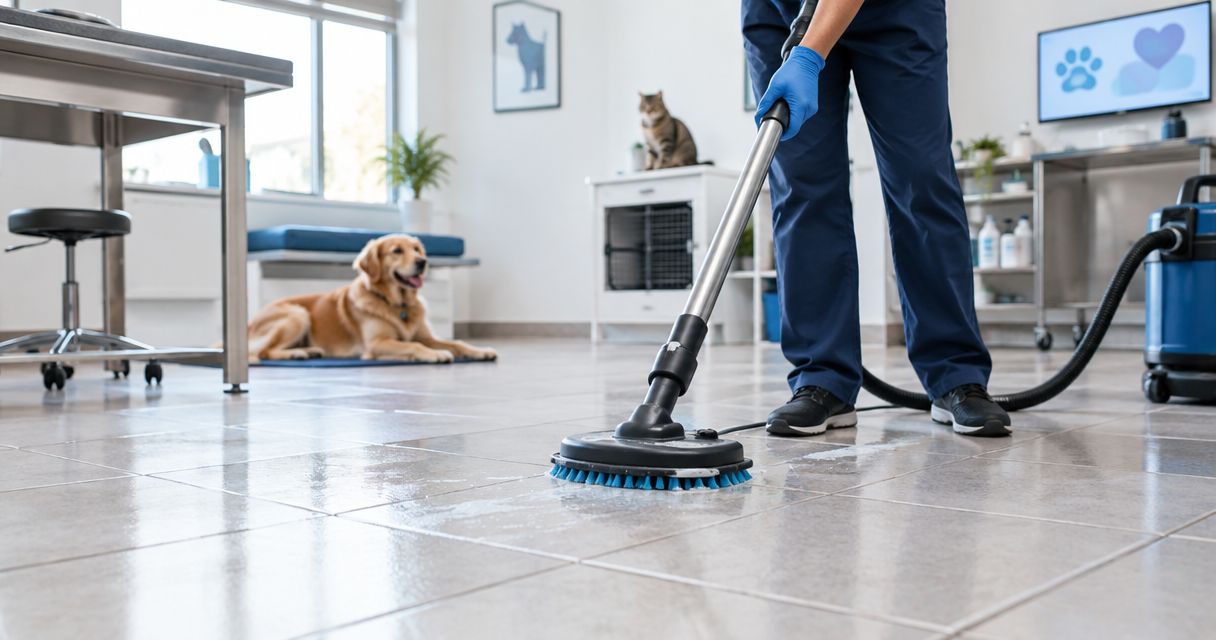
| Clinic-operated machine cleaning | Larger tiled areas with trained operators | Covers open floor areas without hand-scrubbing every joint | Requires compatible equipment, training, and dirty-solution recovery |
| PowerPro Carpet Cleaning tile/grout service | Local businesses needing professional cleaning support | Places the agreed deep-cleaning task with an outside service | Veterinary-specific procedures and surface compatibility must be agreed before work |
| Label-led disinfection | Areas requiring the clinic's approved infection-control procedure | Addresses the registered product's specified microorganism claims | Does not replace soil removal or correct damaged flooring |
Use routine cleaning as the foundation and add the other options for specific needs. Do not select professional deep cleaning because a room needs disinfection, or select disinfectant because grout looks dark. Those decisions address different problems.
Common mistakes veterinary clinics make
Treating clean-looking grout as disinfected
Appearance cannot confirm completion of a disinfectant's label instructions. Keep soil removal and disinfection as separate tasks in the written procedure. Record who completed each task where the clinic requires documentation.
Sharing cleaning tools across restricted areas
A brush, mop, or recovery tool can carry contamination between spaces. Set zone-specific equipment rules and follow the clinic's procedure for cleaning reusable equipment. Do not let convenience determine which tools enter isolation areas.
Using one chemical on every tiled surface
A product approved for one floor is not automatically suitable for another. Check tile, grout, sealer, and product instructions together. Pay particular attention to natural stone and already damaged joints.
Booking work without an animal-access plan
An empty appointment calendar does not guarantee an empty building. Account for hospitalized animals, boarding areas, emergency access, and staff routes. Agree on room closures and reopening authority before the cleaning visit.
Asking deeper cleaning to fix damaged grout
Missing joints, loose tile, and recurring moisture problems need maintenance assessment. Cleaning can remove soil; it cannot restore a failed installation. Document damage and keep repair decisions separate from the cleaning scope.
Arrange service without disrupting patient care
Before you call PowerPro Carpet Cleaning, prepare your floor material information, room list, and access restrictions. Explain whether you want routine-soil removal, attention to embedded grout buildup, or help with another tiled area. Have the clinical lead define any separate disinfection requirements.
Call to discuss your Manalapan Township or Central or North New Jersey location and the proposed tile/grout cleaning scope. Confirm how the work fits around patients before committing the room to service.
Discuss your clinic's tile cleaning
Share your floor materials, problem areas, and animal-access requirements before arranging service.
FAQ
What's the best tile and grout cleaning approach for a veterinary clinic?
The best approach separates soil removal, grout cleaning, and required disinfection. Identify the flooring, use compatible products, and have the clinic's clinical lead approve infection-control procedures.
Does professional tile cleaning disinfect veterinary floors?
Professional tile cleaning does not by itself establish that veterinary floors have been disinfected. Disinfection requires an appropriate registered product and completion of its label instructions within the clinic's approved procedure.
Can our veterinary staff clean grout without a machine?
Staff can clean accessible grout manually with a compatible cleaner and suitable brush. Follow the product instructions, recover dirty solution, and keep cleaning tools within the clinic's zone rules.
How often should a veterinary clinic book professional grout cleaning?
Base professional grout cleaning on documented floor condition and the results of routine cleaning. Persistent buildup and difficult edges justify a service assessment; they do not establish a universal booking interval.
Is stronger disinfectant better for dirty grout?
Stronger disinfectant is not a substitute for removing soil from grout. Use the label's dilution and confirm surface compatibility rather than increasing concentration to address discoloration.
When can animals return after tile and grout cleaning?
Animals can return when the product instructions and clinic reopening procedure have been satisfied. Check drying, residue, contact time, rinsing, ventilation, and any stated animal-access restrictions before releasing the area.
What should a New Jersey clinic tell a cleaning company before booking?
Tell the cleaning company your location, floor materials, problem areas, and animal-access restrictions. Define the cleaning scope separately from veterinary disinfection requirements and identify who approves reopening.
One last thing
The dark line that keeps returning deserves a diagnosis, not another pass with a brush. After cleaning, inspect whether the joint contains remaining soil, permanent discoloration, or damaged grout. Those findings require different next steps.
For your 2026 plan, photograph the same problem area under similar lighting before and after treatment. Keep that record with the maintenance notes. It gives your next cleaning or repair discussion a specific starting point.