Plan professional carpet cleaning every 12 months, using the Carpet and Rug Institute’s 12–18-month residential guideline as your starting range for 2026. Heavy traffic, pets, spills, and your carpet manufacturer’s care requirements can justify cleaning sooner. The calendar does not replace prompt spill treatment, regular vacuuming, or attention to persistent odors.
- How often should carpets be cleaned? The Carpet and Rug Institute recommends professional deep cleaning every 12–18 months.
- Your carpet manufacturer’s cleaning requirements take priority over a general maintenance schedule.
- Pets, tracked-in soil, and repeated spills justify checking busy rooms before the scheduled cleaning date.
- PowerPro Carpet Cleaning serves homeowners and businesses in Manalapan Township and surrounding Central and North New Jersey counties.
How often should carpets be professionally cleaned?
The Carpet and Rug Institute’s published residential carpet-care guidance recommends professional deep cleaning every 12–18 months. That is a maintenance baseline, not a promise that every room stays clean for the same length of time. Use the guidance to plan your 2026 schedule, then check the care instructions for your specific carpet.
For local service, PowerPro Carpet Cleaning provides carpet cleaning for homeowners and businesses in Manalapan Township and surrounding Central and North New Jersey counties. Discuss the carpet’s condition and cleaning history before deciding whether the whole property needs attention.
| Maintenance approach | Best for | Main advantage | Main limitation |
|---|---|---|---|
| Plan around 12 months | Households that want a regular annual reminder | Creates a clear date to review carpet condition and arrange cleaning | Some rooms need attention before the reminder |
| Use the 12–18-month guideline | Residential carpets with ordinary use, subject to manufacturer instructions | Gives a recognized starting range for deep cleaning | Does not account for every household or warranty requirement |
| Arrange earlier assessment | Carpets with recurring soil, spills, or persistent odors | Addresses a specific problem instead of waiting for the calendar | Requires identifying whether cleaning will resolve the problem |
Choose the schedule that fits the carpet, not the longest interval available. A clean-looking spare room and a heavily used family room do not automatically need identical treatment.
Why this matters
Vacuuming removes loose dirt, but it does not replace periodic professional deep cleaning. Dirt carried in on shoes and paws collects in carpet, including places where a quick vacuuming pass misses it. Waiting for an obvious dark traffic lane makes appearance, rather than maintenance, the trigger.
Cleaning too often without considering the material is not the answer either. The cleaning method, moisture control, and drying arrangements matter alongside frequency. A useful plan protects the carpet’s condition without treating every spill as a reason to clean every room.
For your 2026 maintenance calendar, record the last professional cleaning date and locate the manufacturer’s instructions. Those details give you a better starting point than a reminder copied from someone else’s household.
Ordinary household use: Review at 12 months
For a household without a specific cleaning problem, set a review reminder 12 months after professional cleaning. This sits at the earlier end of the Carpet and Rug Institute’s 12–18-month guideline. At the reminder, inspect the main walking routes and check whether the manufacturer requires cleaning by a particular date.
Look at the carpet beside the sofa, through doorways, and near the entrance. Compare those areas with less-used carpet in the same room, allowing for differences in lighting and pile direction. Visible soil is a reason to arrange cleaning, not a reason to keep waiting for the end of the range.
An annual reminder is simple to manage. Its limitation is equally clear: a reminder cannot detect a pet accident or a muddy entrance between appointments. Keep routine maintenance separate from the professional cleaning date.
Lightly used rooms: Check the 12–18-month guideline
A guest bedroom with little foot traffic does not collect soil at the same rate as the main entrance. The 12–18-month residential guideline remains a useful reference, but the carpet’s care instructions still determine what is acceptable. Do not extend the interval solely because the room looks clean.
Check for dust, spills, and changes in use before deciding to postpone cleaning. A room that becomes a home office or playroom no longer has the same traffic pattern. Revisit its schedule when its use changes.
The benefit of a room-by-room assessment is avoiding an automatic whole-house decision. The drawback is that appearance alone cannot tell you whether you have met the manufacturer’s maintenance requirements. Keep the written instructions with your cleaning records.
Pets, children, and busy entrances: Assess sooner when needed
Pets and children change the maintenance workload, but they do not create a universal cleaning interval. Shedding, accidents, food spills, and soil carried indoors are separate issues. Tell the cleaner which problems you have rather than asking for a generic pet-household schedule.
A pet accident needs attention when it happens. Professional cleaning scheduled months later is not a substitute for prompt treatment, and a persistent odor deserves assessment of its source. Surface cleaning alone does not necessarily address contamination beneath the carpet.
Busy entrances deserve the same practical approach. If a Manalapan Township household repeatedly tracks dirt into a hallway, inspect that hallway between scheduled cleanings. Move the assessment forward when the condition changes; do not wait simply because the appointment is not due.
Why professional carpet cleaning frequency varies
The right interval depends on how the carpet is used and maintained. These factors explain why a general residential guideline needs adjustment:
- Foot traffic: Entrances, hallways, and routes between frequently used rooms receive more wear and tracked-in soil than spare bedrooms.
- Pets and spills: Hair, accidents, and food or drink spills create cleaning needs that a fixed calendar does not address.
- Vacuuming habits: Thorough, regular vacuuming helps remove loose soil between professional cleanings. Neglected traffic areas need closer inspection.
- Carpet material and construction: The fiber, backing, and installation affect which cleaning methods are suitable. Confirm the method before work starts.
- Manufacturer requirements: Written care and warranty terms can specify cleaning methods, intervals, and documentation. Follow those requirements rather than general advice.
- Previous cleaning results: Returning spots, lingering odors, or rapid resoiling call for a discussion about the cause, not just another appointment using the same approach.
Use these factors to explain what has changed since the last cleaning. A useful conversation starts with the problem room, the last service date, and the material—not simply the age of the carpet.
How to build your 2026 carpet cleaning schedule
A workable schedule separates routine care from problems that need earlier attention. Follow this sequence before booking, especially if you cannot remember when the carpet was last professionally cleaned.
- Check care instructions. Find the manufacturer’s maintenance guidance and warranty terms. Note any required method or documentation.
- Record the date. Save the last professional cleaning date and invoice. If the history is unknown, ask for a condition assessment rather than assuming the carpet is overdue by a particular amount.
- Inspect traffic areas. Check entrances, hallways, stairs, and the spaces around frequently used furniture. List stains and odors separately from general soil.
- Discuss the method. Explain the carpet material if you know it, previous cleaning problems, and any concerns about moisture or recurring spots.
- Plan room access. Arrange access for the appointment and ask how to manage furniture, ventilation, and use of the rooms afterward.
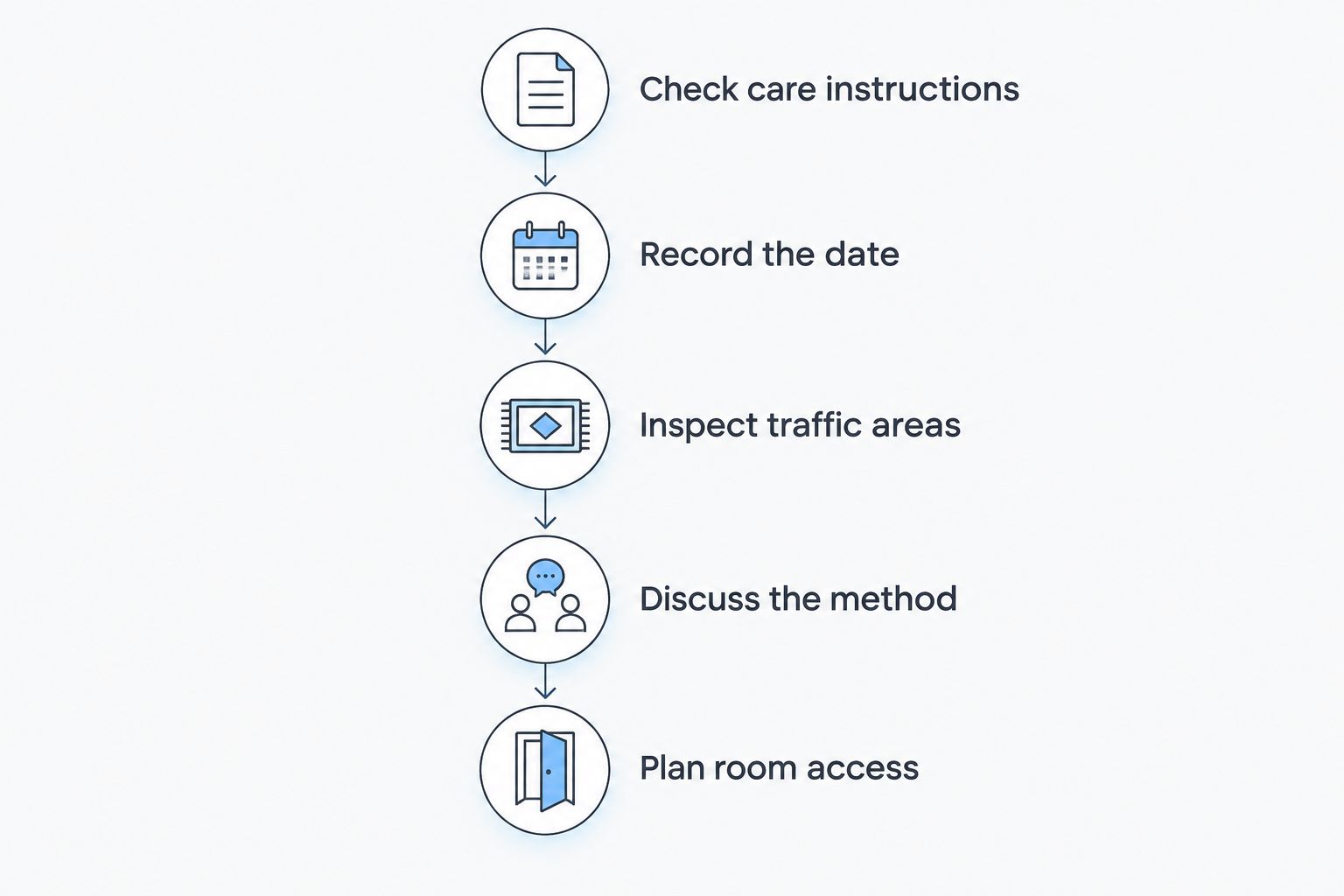
Do not treat booking and drying as the same scheduling question. An appointment needs access to the carpet; the period afterward needs a plan for using the room. Ask about both, and use the guide to professional carpet cleaning appointment length to prepare your questions.
PowerPro Carpet Cleaning is best for homeowners and businesses seeking a local carpet cleaning service in Manalapan Township and surrounding Central and North New Jersey counties. The family-owned business also provides upholstery, area rug, tile/grout, and air duct cleaning. Confirm the cleaning method and suitability for your carpet when you call; the service list does not establish those details for every material.
Discuss your carpet cleaning schedule
Call PowerPro Carpet Cleaning to discuss your carpet’s condition and service needs.
Does vacuuming let you wait longer between professional cleanings?
The 12–18-month guideline still provides a starting point even when you vacuum regularly. Vacuuming and deep cleaning perform different jobs. Good routine care does not cancel the manufacturer’s professional cleaning requirements.
Pay particular attention to walking routes, edges, and places where pets spend time. Follow the carpet and vacuum manufacturers’ instructions for equipment and technique. A carpet that looks tidy after vacuuming can still be due for scheduled deep cleaning.
Should you clean carpet immediately after a spill?
The 12–18-month maintenance interval does not apply to spill response. Act promptly, blot rather than scrub, and follow the carpet manufacturer’s approved spot-cleaning instructions. Avoid experimenting with several household chemicals on the same spot.
Professional help is appropriate when the spill is extensive, the substance is uncertain, or a stain or odor persists. Describe what spilled and what you have already applied. That information matters more than the date of the next routine appointment.
How often should office carpets be professionally cleaned?
The 12–18-month guideline cited here is residential guidance, not a universal commercial schedule. An office entrance, reception area, and lightly used meeting room can have different maintenance needs. Build the commercial plan around traffic, visible soil, operating hours, and the carpet manufacturer’s instructions.
For a New Jersey business planning maintenance in 2026, identify areas that must stay open and discuss how cleaning will affect access. Record recurring problems by location. Avoid applying a household schedule to a busy business simply because both properties have carpet.
What should you ask before booking?
Ask the cleaner how the proposed method fits your carpet and how the appointment will address the problems you have identified. A clear answer should distinguish routine soil removal from stain treatment, odor assessment, or a problem beneath the carpet. Do not assume those are interchangeable.
Use these questions on the call:
- What information do you need about the carpet’s fiber and care instructions?
- Which rooms need professional cleaning now, and which need inspection first?
- How will you assess recurring stains or odors?
- What furniture and small items should be moved before the appointment?
- What instructions should you follow while the carpet dries?
- What documentation should you keep for the manufacturer’s warranty?
For your 2026 records, save the invoice and any written care advice together. A documented schedule is more useful than a date you have to guess next time.
FAQ
How often should carpets be cleaned professionally?
The Carpet and Rug Institute recommends professional deep cleaning every 12–18 months for residential carpet. Follow your carpet manufacturer’s requirements and arrange earlier assessment when soil, stains, or odors need attention.
Is cleaning carpet once a year enough?
Cleaning every 12 months is a practical starting point within the Carpet and Rug Institute’s 12–18-month residential guideline. It is not enough to ignore spills, recurring odors, or manufacturer requirements between appointments.
How often should carpets be cleaned if I have pets?
Pets do not create one universal cleaning interval. Use the 12–18-month residential guideline as a reference, follow the manufacturer’s instructions, and address accidents or persistent odors promptly.
Do I need professional cleaning if I vacuum regularly?
Yes, regular vacuuming does not replace professional deep cleaning. Vacuuming removes loose soil, while periodic professional cleaning remains part of residential carpet maintenance.
Should every room be cleaned on the same schedule?
Not automatically: rooms with different traffic levels need separate assessment. Check each room’s condition while meeting the carpet manufacturer’s cleaning requirements.
Can professional carpet cleaning fix every stain or odor?
No, professional cleaning cannot guarantee removal of every stain or odor. Permanent discoloration or contamination beneath the carpet can require a different response.
Who should I call about a local carpet cleaning schedule?
PowerPro Carpet Cleaning serves homeowners and businesses in Manalapan Township and surrounding Central and North New Jersey counties. Call to discuss the rooms, the last cleaning date, and any recurring stains or odors before arranging service.
One last thing
A recurring spot is useful information, not just an appearance problem. If the same mark returns after cleaning, record its location and tell the cleaner what happened there. Repeating the same surface treatment without discussing the history does not address why it keeps returning.
Before you set your next reminder, write down the last cleaning date, the carpet’s care requirements, and the rooms that need closer attention. That gives your 2026 schedule a clear purpose: routine maintenance for the whole carpet, with earlier action where conditions demand it.