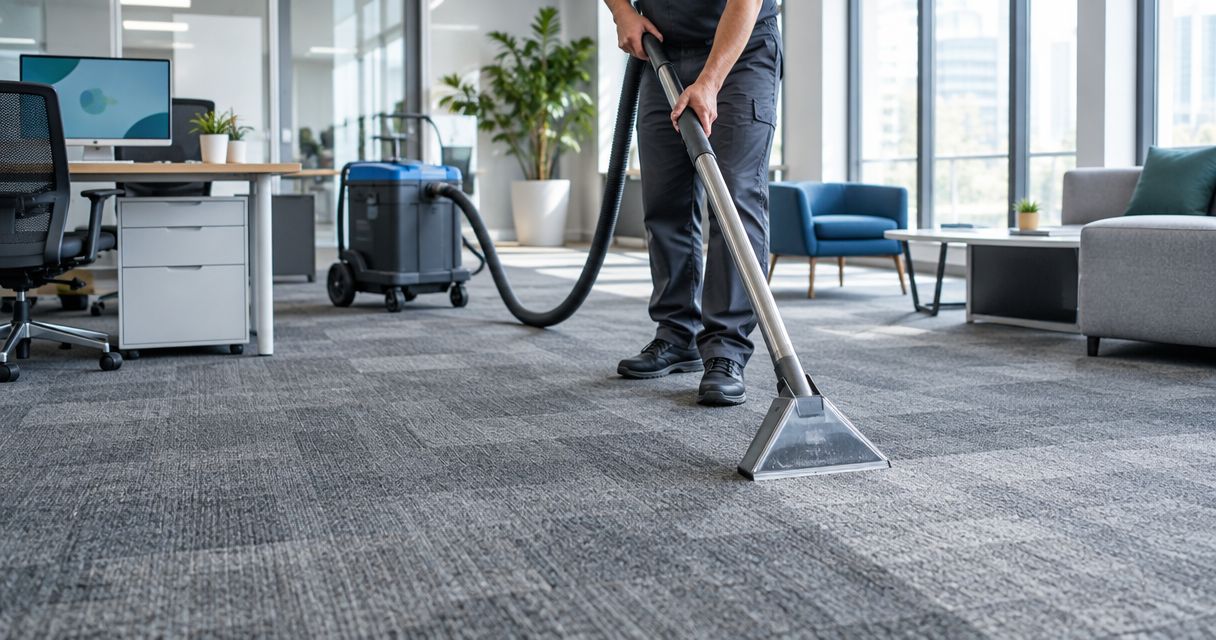
Clean office carpets on a schedule based on foot traffic, soil buildup, and the carpet manufacturer’s maintenance instructions—not one fixed interval for the entire building. Vacuuming and prompt spill cleanup belong between professional cleanings; they do not replace them. For your 2026 maintenance plan, give entrances, reception areas, and busy corridors more attention than lightly used rooms, and arrange cleaning before tracked-in soil becomes a persistent traffic lane.
- How often clean commercial carpet office? Set professional cleaning intervals by traffic, soil buildup, and manufacturer instructions.
- Vacuuming and spot cleaning support commercial carpet maintenance; neither replaces periodic professional cleaning.
- PowerPro Carpet Cleaning serves office carpet cleaning customers in Manalapan Township and surrounding Central and North New Jersey counties.
- Use separate maintenance schedules for busy entrances, shared corridors, and lightly used office rooms.
How often should commercial carpets be cleaned in an office?
Schedule professional office carpet cleaning by zone, not just by calendar. Start with the manufacturer’s written care instructions, then adjust the plan to the amount and type of soil each area receives. A reception area beside an exterior door does not need the same attention as a conference room used occasionally.
When discussing carpet cleaning services, describe where dirt appears first and what your cleaning staff already handles. That information helps define the work more clearly than the office’s total floor area alone.
| Office area | Best maintenance focus | Main benefit | Limitation to address |
|---|---|---|---|
| Entrances and reception | Best for targeted attention to tracked-in soil | Concentrates effort where outdoor dirt enters | Cleaning carpet alone leaves dirty entrance mats unaddressed |
| Shared corridors | Best for traffic-lane inspection and vacuuming | Focuses care on repeated walking routes | Some dark lanes reflect wear rather than removable soil |
| Desks and workstations | Best for accessible vacuuming and spill response | Addresses food debris and local soil | Furniture restricts access unless preparation is agreed upon |
| Conference rooms | Best for use-based inspection | Connects care to actual room use | Meetings and catered events change the cleaning need |
| Lightly used rooms | Best for condition-based scheduling | Avoids treating every room as equally busy | Low traffic does not eliminate spills or maintenance requirements |
Why this matters
A single building-wide appointment is easy to record, but it ignores how an office operates. Employees repeat the same routes between doors, desks, printers, and break areas. Those routes need closer inspection than carpet under rarely moved furniture.
Your 2026 plan should separate routine housekeeping from professional carpet cleaning. Vacuuming removes loose dry soil; spot treatment addresses individual marks; professional cleaning addresses accumulated soil using a method suited to the carpet. Each task has a different job.
Do not wait for every room to look dirty before addressing the busiest areas. Equally, do not assume that an untouched-looking room is exempt from the manufacturer’s care requirements.
Entrances and reception: prioritize tracked-in soil
Entrances are the starting point for outdoor dirt and moisture. In a New Jersey office, inspect the carpet beyond the entry mat as well as the mat itself. Dirt that passes the mat continues into reception and connecting corridors.
Make entrance care a coordinated task:
- Keep entry mats clean and correctly positioned.
- Vacuum the carpet beyond the mats, including edges and corners.
- Remove tracked-in debris before it spreads through the office.
- Report persistent marks that remain after routine care.
- Arrange professional cleaning when the area’s condition calls for it.
The benefit of targeted entrance cleaning is clear: you focus attention on an active source of soil. The limitation is equally important. Cleaning the carpet without maintaining the entry mats leaves part of the problem in place.
Do not use reception appearance alone to judge the entire building. Inspect connecting hallways and the route to shared facilities before deciding the cleaning scope.
Shared corridors: inspect the walking lanes
Corridors receive repeated foot traffic along narrow routes. Look for changes between the center walking lane and the edges, especially near turns, doorways, and transitions from hard flooring.
A darker lane needs assessment, not a promise that every difference will disappear. Accumulated soil, pile direction, and physical wear do not respond to cleaning in the same way. Ask the cleaner to distinguish likely soil removal from permanent appearance changes before work begins.
For your 2026 schedule, record whether the same lane becomes visibly soiled again between visits. That record gives you a practical basis for changing the corridor’s cleaning interval without automatically increasing work in every office.
Professional cleaning removes soil; it does not reverse worn carpet fibers. Set that expectation before approving the job.
Workstations and meeting rooms: schedule around actual use
Desk areas need access as well as cleaning. Chair bases, cables, stored boxes, and personal items restrict where a vacuum or cleaning tool reaches. Agree on preparation before the appointment rather than discovering blocked areas when the cleaner arrives.
Conference rooms need a different check. A room used occasionally for meetings has a different soil pattern from a room used for catered training sessions. Inspect after food service and address spills promptly instead of saving them for the next general cleaning.
The advantage of a use-based plan is that it follows the room’s actual condition. Its limitation is that someone must inspect and report changes. Assign that responsibility to a named staff role so lightly used spaces do not become forgotten spaces.
Why office carpet cleaning frequency varies
The right interval depends on conditions in the building and the carpet’s care requirements. Review these factors when setting or changing the schedule:
- Foot traffic: Repeated walking concentrates soil and wear along particular routes. Inspect those routes separately from quiet rooms.
- Outdoor exposure: Exterior doors, entrance mats, and the path from outside affect where tracked-in soil appears.
- Food and drinks: Break areas, desk lunches, and catered meetings create local spill risks that a calendar alone cannot address.
- Routine maintenance: Effective vacuuming and prompt spill response support the professional cleaning plan. Missed areas need correction, not just another appointment.
- Carpet requirements: Fiber, construction, backing, and written care instructions affect suitable methods and maintenance expectations.
- Access and drying: Furniture, occupied rooms, and reopening needs affect how the work is organized. Confirm these before booking.
Avoid judging the schedule by color alone. Patterned or darker carpet can make soil less obvious, while lighter carpet reveals marks more readily. Appearance is useful evidence, but it is not a substitute for written care instructions and inspection.
How to build an office carpet maintenance plan
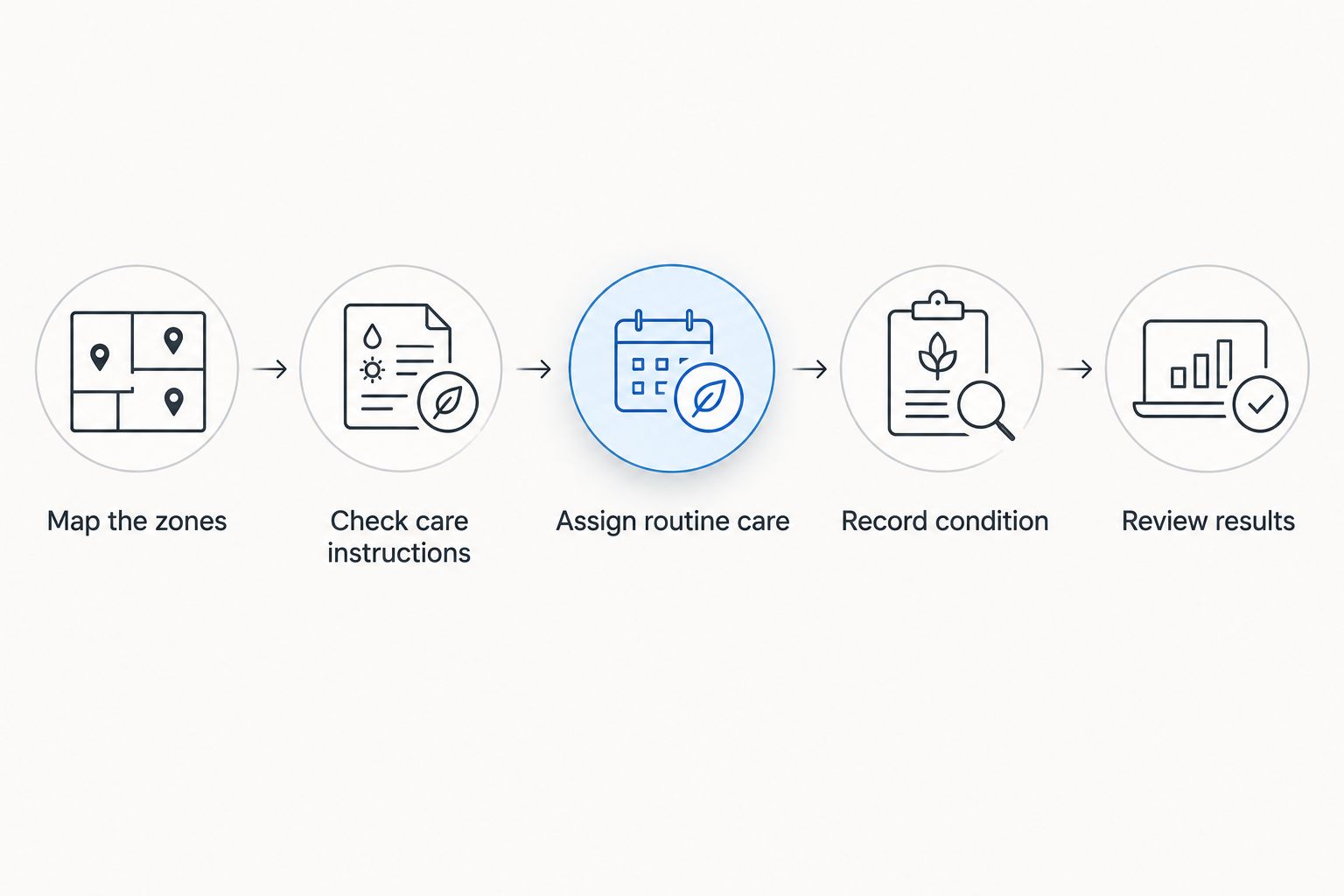
Turn the cleaning schedule into a short working document your office manager and cleaning staff can both use. For 2026, record the actual rooms and routes rather than writing only “clean office carpets.”
- Map the zones. Identify entrances, reception, corridors, workstations, meeting rooms, and any carpeted food areas. Mark where soil first becomes noticeable.
- Check care instructions. Keep the manufacturer’s maintenance guidance and applicable warranty documents with the plan. Confirm suitable cleaning methods before approving treatment.
- Assign routine care. State who vacuums, who handles spills, and who reports persistent stains. Include areas around furniture that are easily missed.
- Record condition. Note traffic lanes, recurring spots, odors, damaged seams, and any dampness. Photographs help document appearance without relying on memory.
- Review results. After professional cleaning, record what improved and what remained. Use the carpet’s condition between visits to reassess the next appointment.
The process works only if inspection leads to action. A recurring spill location needs a housekeeping change; a damaged seam needs assessment rather than repeated stain treatment.
What should you confirm before booking professional cleaning?
Confirm the scope, access arrangements, and reopening requirements before approving the appointment. A clear work description prevents confusion about furniture, spots, and rooms that remain occupied.
Ask these questions:
- Which carpeted areas are included, and which are excluded?
- Which method suits this carpet and its written care instructions?
- Who moves chairs, small items, and other agreed furniture?
- Which marks need separate assessment before treatment?
- How will staff avoid the work area during cleaning and drying?
- Who checks the carpet before normal use resumes?
Do not assume an evening appointment guarantees the carpet will be ready when staff arrive. Drying depends on the method, moisture left in the carpet, airflow, and room conditions. Agree on the reopening decision rather than relying on an unsupported drying promise.
PowerPro Carpet Cleaning is best suited to office managers seeking a local carpet cleaning service in Manalapan Township and surrounding Central and North New Jersey counties. The family-owned business serves homeowners and businesses; discuss your office’s carpet condition and access needs before arranging service.
Call PowerPro Carpet Cleaning to discuss the areas that need attention, or use the contact page to describe your office and request service information.
Plan your office carpet cleaning
Discuss carpet condition, room access, and cleaning needs for your New Jersey office.
Is annual office carpet cleaning enough?
Annual office carpet cleaning is not automatically enough for every office or every room. Check the manufacturer’s requirements and whether entrances or walking lanes need attention before the next planned visit.
An annual appointment is a calendar choice, not proof that the carpet’s maintenance needs are being met. Keep routine care and condition checks active between professional visits.
Does daily vacuuming replace professional carpet cleaning?
Daily vacuuming does not replace professional carpet cleaning. Vacuuming addresses loose dry soil, while professional cleaning addresses accumulated soil using a carpet-appropriate process.
Keep both tasks in the maintenance plan. If traffic lanes remain dark after vacuuming, arrange an assessment rather than assuming more passes will resolve the problem.
Should you clean the whole office at the same time?
Whole-office cleaning is not required every time one area needs attention. Zone-based work lets you address a busy entrance or corridor without treating lightly used rooms as equally soiled.
The trade-off is coordination. Confirm that targeted cleaning follows the carpet’s care instructions and that adjoining areas will not immediately track soil back onto the cleaned section.
FAQ
How do I know when office carpet needs professional cleaning?
Arrange an assessment when routine vacuuming and appropriate spot care no longer address visible soil or recurring marks. Also follow the carpet manufacturer’s maintenance instructions rather than waiting for obvious discoloration.
Should office entrance carpets be cleaned more often than private offices?
Office entrances need closer inspection because they receive tracked-in outdoor soil. Set their cleaning schedule separately when their condition differs from private offices.
Can our janitorial team handle all office carpet maintenance?
A janitorial team can handle assigned routine care, but its carpet-cleaning equipment, training, and methods must match the work required. Confirm who handles professional cleaning and who handles everyday vacuuming and spills.
Will professional cleaning remove every dark traffic lane?
Professional cleaning does not remove every dark traffic lane because some appearance changes come from wear or pile distortion rather than soil. Ask for an assessment before treating restoration as a guaranteed result.
Can we have the carpets cleaned while employees are working?
Cleaning during working hours requires a plan that keeps employees away from active work areas and manages access during drying. Confirm whether the office layout supports that arrangement before booking.
What should we do if office carpet is wet from a leak?
Address the leak and arrange prompt assessment rather than waiting for routine carpet cleaning. Wet carpet and affected underlying materials require a response suited to the water source and extent of damage.
How should we update our office carpet cleaning schedule for 2026?
Update your 2026 schedule using manufacturer instructions, room use, and recorded carpet condition between cleanings. Keep separate entries for busy entrances, shared corridors, and lightly used rooms.
One last thing
Inspect the route from the entrance to the busiest shared area before setting your next appointment. That route connects where outdoor soil enters with where employees repeatedly walk. It gives you a practical starting point for deciding which zones need attention first.
Keep a simple record of what you find and share it when arranging service. A room-by-room description is more useful than “the whole carpet looks tired,” and it helps keep the cleaning discussion focused on actual conditions.