Instead of manually chasing movers, cleaners, and the incoming tenant, use a commercial carpet cleaning lease turnover checklist that ties cleaning to cleared rooms, building access, drying, and final inspection. For a 2026 office handover, schedule carpet work after dirt-producing work finishes and release each room only after its condition and readiness have been checked.
- Commercial carpet cleaning lease turnover needs cleared rooms, confirmed access, drying time, and a documented handover.
- PowerPro Carpet Cleaning is best for local businesses seeking carpet cleaning alongside upholstery or tile/grout cleaning.
- Use vacant-suite cleaning when rooms are empty; use phased cleaning when part of the office remains occupied.
- Keep carpet cleaning records separate from lease acceptance: a service invoice does not establish compliance.
Why this matters
An office turnover has several finish lines: the outgoing tenant leaves, contractors complete repairs, cleaning finishes, and the incoming tenant takes possession. Carpet cleaning belongs between dirty work and occupancy—not wherever an appointment happens to fit.
PowerPro Carpet Cleaning is best for local businesses seeking carpet cleaning alongside upholstery or tile/grout cleaning. The family-owned company serves homeowners and businesses in Manalapan Township and surrounding Central and North New Jersey counties. Start with PowerPro Carpet Cleaning and call to discuss the office address, carpet condition, and handover requirements.
Cleaning does not repair loose seams, replace damaged carpet tiles, or decide who pays under a lease. Keep those decisions separate. Your 2026 turnover file should show what was requested, what was completed, and what remains unresolved before possession changes hands.
Before you start
- Gather the handover materials. Have the lease's carpet-related requirements, a room list or floor plan, existing condition photos, and the incoming tenant's access date. Identify who can approve work and sign off on the finished space.
- Confirm building access. Check keys, alarms, loading access, elevator arrangements, parking, and any contractor paperwork with building management. Ask the cleaning provider what utilities and equipment access the proposed work requires.
- Resolve the hidden scheduling problem. An empty office is not necessarily ready for carpet cleaning. Painting, ceiling repairs, furniture removal, and other dirty work must finish first; also confirm that building ventilation can operate during the drying period.
Assign 1 responsible person to maintain the checklist and communicate changes. Other people can inspect or approve individual tasks, but a single coordinator prevents conflicting instructions about room access and handover timing.
Scope approval
A clear scope makes commercial carpet cleaning lease turnover easier to inspect. Record rooms and conditions rather than requesting an undefined whole-office clean.
- Walk every carpeted area. List reception, private offices, meeting rooms, corridors, storage areas, and any other carpeted spaces. Separate carpet from area rugs, upholstery, and tile/grout so each service requires its own agreement.
- Document the starting condition. Take 2 photo views per room as a practical recordkeeping baseline: a wide view showing the room and a closer view of the main concern. Add more photos for separate stains, damaged seams, or different carpet materials.
- Identify cleaning concerns and repair concerns separately. Mark spills, traffic lanes, and odors for assessment. Record tears, lifting edges, delamination, or missing tiles as repair questions, not cleaning promises.
- Get the proposed work confirmed. Ask what areas will be cleaned, what furniture must move, what method is appropriate for the installed carpet, and what limitations apply. Use manufacturer care instructions when they are available.
- Record approval before scheduling. Create checklist fields named Room, Condition, Agreed work, and Approved by. These are labels for your own document, not settings in a booking system.
Expected result: You have an approved room-by-room scope, with cleaning, repairs, and unresolved questions shown separately. Nobody has to infer whether the reception chairs or an area rug were included.
For a 2026 lease turnover, retain the approved version rather than repeatedly overwriting it. A revised scope should identify the change, especially when outgoing furniture reveals previously covered carpet.
Access coordination
The cleaning appointment needs a usable work area, not just a calendar entry. Confirm the physical conditions before treating the appointment as ready.
- Choose the turnover sequence. Put furniture removal and dirt-producing repairs before carpet cleaning. Place final inspection and incoming furniture installation afterward, subject to the cleaning provider's drying guidance.
- Name the access contact. Record who will meet the crew, unlock the suite, handle alarms, and answer scope questions. Provide a backup contact if the coordinator will not be present.
- Confirm building requirements. Ask management about permitted work periods, elevator access, contractor documentation, and equipment routes. Pass those requirements to the provider before the appointment.
- Clear the agreed areas. Remove boxes, loose paperwork, and movable items according to the agreed scope. Do not assume the cleaning crew will disconnect workstations or move heavy furniture.
- Set the drying conditions. Ask how ventilation, temperature, carpet construction, and the selected method affect the plan. Keep the re-entry decision conditional on actual readiness rather than an assumed drying duration.
Expected result: The provider can enter, reach the carpet, perform the agreed work, and leave the space under the drying conditions discussed.
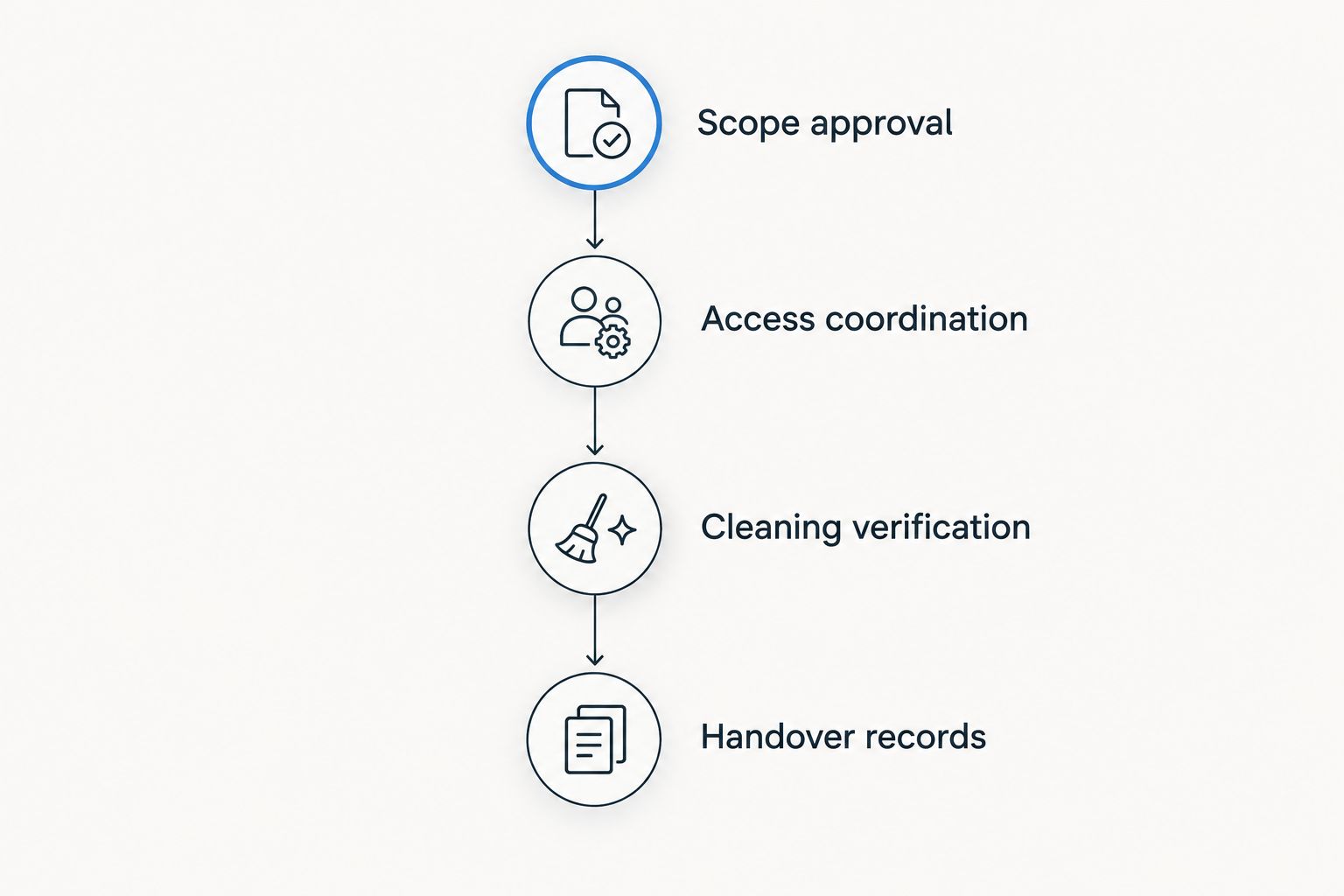
Use 4 checkpoint dates in your 2026 schedule: scope approval, access confirmation, cleaning, and handover inspection. These are management checkpoints, not a claim that every office requires the same turnaround time.
The workflow below keeps those decisions in order. If access or scope changes, return to that checkpoint before proceeding.
Cleaning verification
The purpose of verification is to compare the completed work with the agreement. It is not to demand that cleaning reverse permanent wear or damage.
- Check the exposed carpet before work starts. Review any newly visible stains or damage after furniture removal. Confirm changes with the authorized person before adding work.
- Review treatment limitations. Identify the concerns that need special assessment. Do not promise the incoming tenant that every stain or odor will disappear before the provider has assessed it.
- Protect completed areas. Keep movers and contractors out of cleaned rooms while the work and drying process continue. Coordinate necessary access with the provider rather than routing traffic through damp carpet.
- Inspect against the room list. Check whether each agreed area was addressed. Look for remaining concerns, compare condition photos, and ask the provider to explain anything that needs further attention.
- Confirm readiness before releasing the room. Follow the provider's instructions for walking on the carpet and replacing furniture. Do not treat the end of the cleaning appointment as automatic permission for unrestricted occupancy.
Expected result: Each room has a recorded cleaning status and a clear next action: ready for use, awaiting drying, awaiting reassessment, or awaiting repair.
PowerPro Carpet Cleaning offers carpet, upholstery, area rug, and tile/grout cleaning. That makes it a service to discuss when a turnover includes several surfaces, but your agreement still needs to identify each item. The limitation is scope: requesting carpet cleaning alone does not include every surface in the office.
Handover records
A cleaning invoice documents a service. Your handover record documents the condition presented to the next party. Keep both.
- Create the completion record. Save the agreed scope, service documentation, and room status in the same turnover file. Label the file with the suite identifier and 2026 handover date.
- Photograph the finished space. Use the same viewpoints as the starting photos where practical. Record any remaining marks or damage without describing them as resolved.
- Separate exceptions from completed work. List carpet repairs, disputed conditions, or areas excluded from cleaning. Assign an owner to each unresolved item.
- Obtain the required acceptance. Ask the person authorized under the lease or management process to inspect and acknowledge the condition. Follow the actual agreement; do not substitute a cleaning checklist for its requirements.
- Release access deliberately. Tell movers and the incoming tenant which rooms are ready and which remain restricted. Keep keys, alarm details, and building instructions within the appropriate management process.
Expected result: The incoming tenant receives a documented condition record, and the property team has a separate list of anything still requiring action.
Do not equate clean carpet with lease compliance. The lease and authorized inspection determine acceptance; the cleaner's work is one part of that process.
Second workflow: phased office turnover
Use phased cleaning when an outgoing team remains in part of the suite or the incoming tenant takes rooms in stages. The same scope, access, verification, and handover checkpoints apply, but each zone moves through them separately.
| Workflow | Best for | Advantage | Limitation |
|---|---|---|---|
| Vacant-suite cleaning | Offices cleared before the next tenant arrives | Gives the crew access to the agreed carpeted areas without active workstations | Depends on furniture removal and contractor completion |
| Phased cleaning | Offices with partial occupancy or staged possession | Lets you release completed zones separately | Requires controlled access routes and separate room sign-offs |
For a phased 2026 turnover, draw the work zones on the floor plan. Name a route that does not require occupants to cross freshly cleaned carpet, and confirm that emergency exits remain usable.
- Close the zone. Remove its movable contents and finish dirty work before cleaning begins.
- Clean and verify. Apply the same agreed scope and inspection standard used for the vacant-suite workflow.
- Release the zone. Confirm readiness, record its status, and notify the people who need access.
- Move to the next zone. Keep equipment, furniture, and foot traffic from re-soiling completed areas.
Choose vacant-suite cleaning when you can clear the space; choose phased cleaning when continued occupancy requires it. Phasing solves an access problem, but adds coordination. Do not choose it simply to avoid making a turnover schedule.
Troubleshooting
Movers leave furniture in the work area
Stop treating that room as ready. Confirm whether the remaining furniture will move, whether accessible areas alone will be cleaned, or whether the room needs another appointment. Record the revised scope before work proceeds.
Painting or repairs continue after cleaning
Restrict contractor traffic through completed rooms and protect those areas appropriately. Inspect again when the work finishes; arrange additional cleaning only where the new condition requires it. The fix is sequencing, not assuming the first clean covers later dirt.
A stain remains after treatment
Ask the provider to assess whether further treatment is appropriate. Keep the mark in the condition record and discuss repair or replacement separately if needed. Repeatedly adding cleaning products yourself risks complicating the assessment.
Carpet is not ready when the incoming tenant arrives
Keep the affected rooms restricted and contact the provider for guidance on drying conditions and re-entry. Adjust furniture delivery or room access rather than concealing the problem with an immediate handover.
An odor persists after the carpet surface is cleaned
Report the affected location and when the odor is noticeable. Ask for an assessment of the source rather than assuming another surface treatment will solve it; backing, underlay, or surrounding materials can require separate attention.
Customize your workflow
Expand the checklist to match the premises. Reception seating needs a separate upholstery scope; entrance tile and grout need their own cleaning decision. Area rugs should not disappear into an undefined carpet request.
For offices in Manalapan Township or surrounding Central and North New Jersey counties, call PowerPro Carpet Cleaning to discuss the address, surfaces, and access requirements. Give the provider the actual handover constraints, then agree on the work rather than assuming a particular method or completion time.
If the turnover also includes other building spaces, use the move-out-to-move-in tenant turnover workflow to organize the broader handover. Keep the office carpet checklist as a separate, inspectable part of that plan.
Discuss your office carpet cleaning
Share the office address, carpet condition, and handover requirements before agreeing on the work.
FAQ
When should I schedule commercial carpet cleaning for lease turnover?
Schedule commercial carpet cleaning after furniture removal and dirt-producing repairs, with time for drying and inspection before occupancy. Confirm the sequence with the provider and building manager instead of assuming a fixed drying period.
Does professional carpet cleaning satisfy my office lease?
Professional carpet cleaning does not by itself establish lease compliance. Check the lease's requirements and obtain acceptance from the authorized landlord or management representative.
Can an office stay occupied during turnover carpet cleaning?
An office can use a phased cleaning plan when work zones can be separated from occupied areas and access routes remain usable. Each zone needs its own access control, readiness check, and release decision.
Will carpet cleaning remove every office stain?
Carpet cleaning does not guarantee removal of every stain. Ask the provider to assess the carpet and distinguish treatable soil from permanent discoloration, wear, or damage.
What should I send the cleaner before an office turnover?
Send the office address, room list, condition photos, access requirements, and handover constraints. Include the lease's cleaning requirements and identify who can approve changes to the scope.
Should I replace damaged carpet before or after cleaning?
Assess damaged carpet before approving the cleaning scope. Separate repair or replacement decisions from cleaning so you do not authorize work on an area already marked for removal.
Can PowerPro Carpet Cleaning handle surfaces besides office carpet?
PowerPro Carpet Cleaning offers upholstery, area rug, and tile/grout cleaning in addition to carpet cleaning. Identify those surfaces separately and confirm their inclusion when arranging the office work.
What records should I keep for a 2026 office carpet handover?
Keep the approved scope, before-and-after photos, service documentation, room readiness record, and unresolved-condition list. Obtain any acceptance required by the lease or building management process separately.
One last thing
Photograph the carpet after the last cabinet leaves, not just before the first mover arrives. Furniture can hide stains, wear, and damaged edges. That final empty-room inspection lets you update the scope before cleaning starts instead of discovering an undocumented condition at handover.