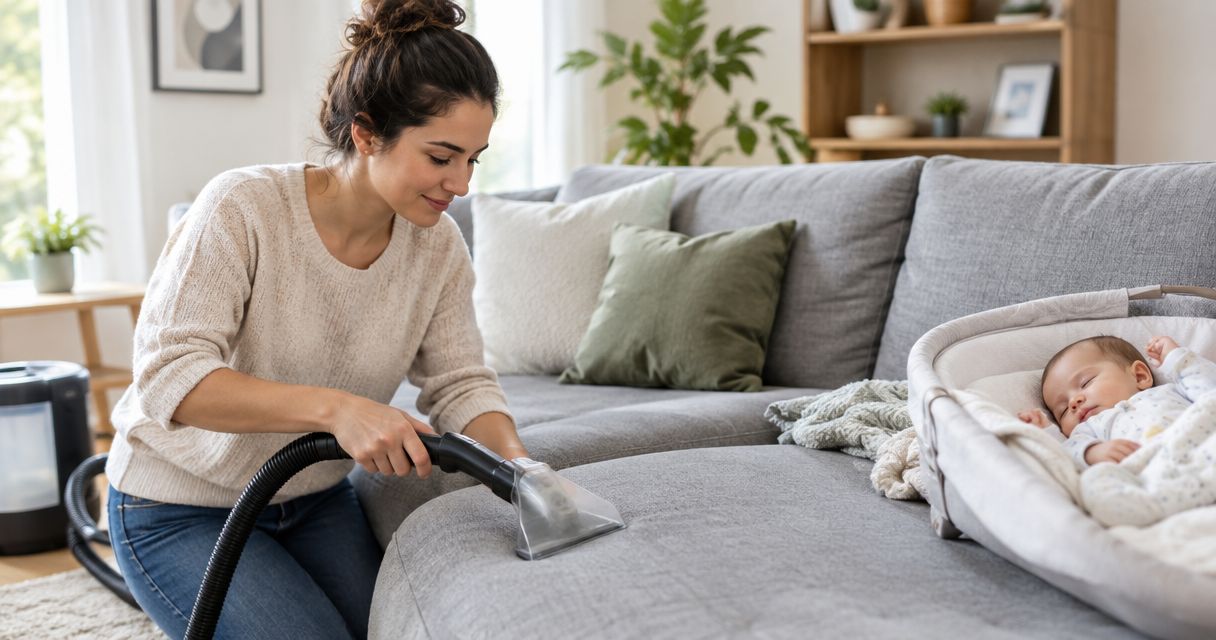
Yes, you can clean a couch with a newborn in the house when you follow the upholstery instructions and cleaning-product label, keep your baby away from the work area, and meet all ventilation, drying, and re-entry requirements before reuse. A dry couch alone does not establish that a cleaning product is safe for infant contact. If your newborn has breathing problems or specific medical restrictions, ask your pediatrician about the proposed products and setup before scheduling.
- Safe couch cleaning with newborn in house requires label-approved upholstery care, separation, ventilation, and complete drying.
- PowerPro Carpet Cleaning provides upholstery cleaning in Manalapan Township; discuss newborn precautions before booking.
- Fragrance-free does not mean harmless, and a dry surface does not replace product-label re-entry instructions.
- Keep your newborn’s bassinet, feeding supplies, and blankets outside the cleaning area.
Is it safe to clean a couch with a newborn in the house?
Yes, with a product-specific plan—not a blanket promise that every cleaning method is baby-safe. Your newborn does not need to be beside the couch during cleaning. Arrange care in a separate, unaffected space, and decide whether remaining elsewhere is more practical if you cannot control exposure within the home.
For a 2026 appointment, start by reviewing the available cleaning services and asking which upholstery method fits your couch. The important distinction is between removing soil from furniture and deciding when a baby can return to the treated room.
Use this sequence before anyone starts:
- Check upholstery instructions. Find the care label and the furniture manufacturer’s cleaning directions. Photograph them for the cleaner.
- Confirm cleaning products. Ask what will touch the fabric, including pretreatments, spot removers, deodorizers, and optional protectants.
- Separate baby supplies. Move your newborn, bassinet, bottles, pump parts, blankets, and toys away from the work area.
- Ventilate as directed. Follow product instructions and keep the baby away from spray, mist, fumes, equipment, and hoses.
- Check before reuse. Meet the label’s re-entry requirements and confirm that cushions, seams, and treated surfaces are fully dry.
Do not proceed while basic questions remain unanswered. A company’s general reassurance is not a substitute for knowing the products and instructions that apply to your appointment.
Why this matters
Couch cleaning creates a temporary work area inside a space where you feed, hold, and settle your newborn. Plan another place for those activities before the technician arrives or you open a cleaning bottle.
The goal is ordinary soil removal without unnecessary exposure. You do not need to add fragrance, disinfectant, or fabric protection simply because a newborn lives in the home. Each additional treatment needs its own reason, upholstery compatibility check, and label review.
For your 2026 cleaning plan, keep two decisions separate: whether the couch needs cleaning and whether the proposed treatment suits your household. A visible stain answers the first question, not the second.
Which couch-cleaning approach fits your situation?
The best approach depends on the furniture instructions and the problem you need to remove. More intensive treatment is not automatically a better choice.
| Approach | Best for | Main benefit | Main limitation |
|---|---|---|---|
| Care-label-permitted vacuuming | Loose crumbs, dust, and surface debris | Avoids adding liquid cleaning products | Does not remove every stain or embedded soil |
| Manufacturer-approved spot cleaning | A small, localized spill | Limits treatment to the affected area | Requires careful product selection and can leave marks if done incorrectly |
| Professional upholstery assessment and cleaning | Broader soiling or an uncertain cleaning method | Lets you discuss fabric care and treatment before work starts | Still requires product review, separation, and drying arrangements |
| Postponing nonessential treatment | A household that cannot separate the newborn from the work area | Avoids an unsuitable appointment setup | Leaves the cleaning task unresolved |
Choose the least intensive approach that addresses the actual problem and follows the furniture instructions. Do not soak an entire cushion to remove a small mark, and do not use a carpet-cleaning product on upholstery unless its label permits that use.
A removable cushion cover is not automatically machine-washable. Check the instructions before taking it off, adding detergent, or putting it in a dryer.
What should you check on the couch label?
Common upholstery care codes distinguish water-based cleaning, solvent-based cleaning, and vacuum-only care. They guide fabric treatment; they do not certify a product for use around newborns.
- W: Water-based upholstery cleaning is generally permitted under the manufacturer’s directions.
- S: Follow instructions for solvent-based upholstery care; do not assume water extraction is suitable.
- WS or SW: The manufacturer permits specified water-based or solvent-based methods.
- X: Use vacuuming or light brushing as directed rather than applying liquid cleaners.
If the label is missing, unreadable, or inconsistent with other furniture instructions, stop before applying a product. Ask the manufacturer or an upholstery professional to identify an appropriate method.
A hidden-area test checks for problems such as color transfer or fabric changes. It does not establish infant safety, acceptable airborne exposure, or a safe return time. Those questions require the cleaning-product instructions and, when needed, medical advice.
How should you prepare the room?
Set up the baby’s care space before cleaning begins. Choose a location away from the treatment area, with feeding and changing supplies already available so you do not need to cross the work zone repeatedly.
Move loose baby items rather than covering them beside the couch. Keep cleaning bottles and equipment inaccessible, and tell every adult in the home which room is off-limits during the work.
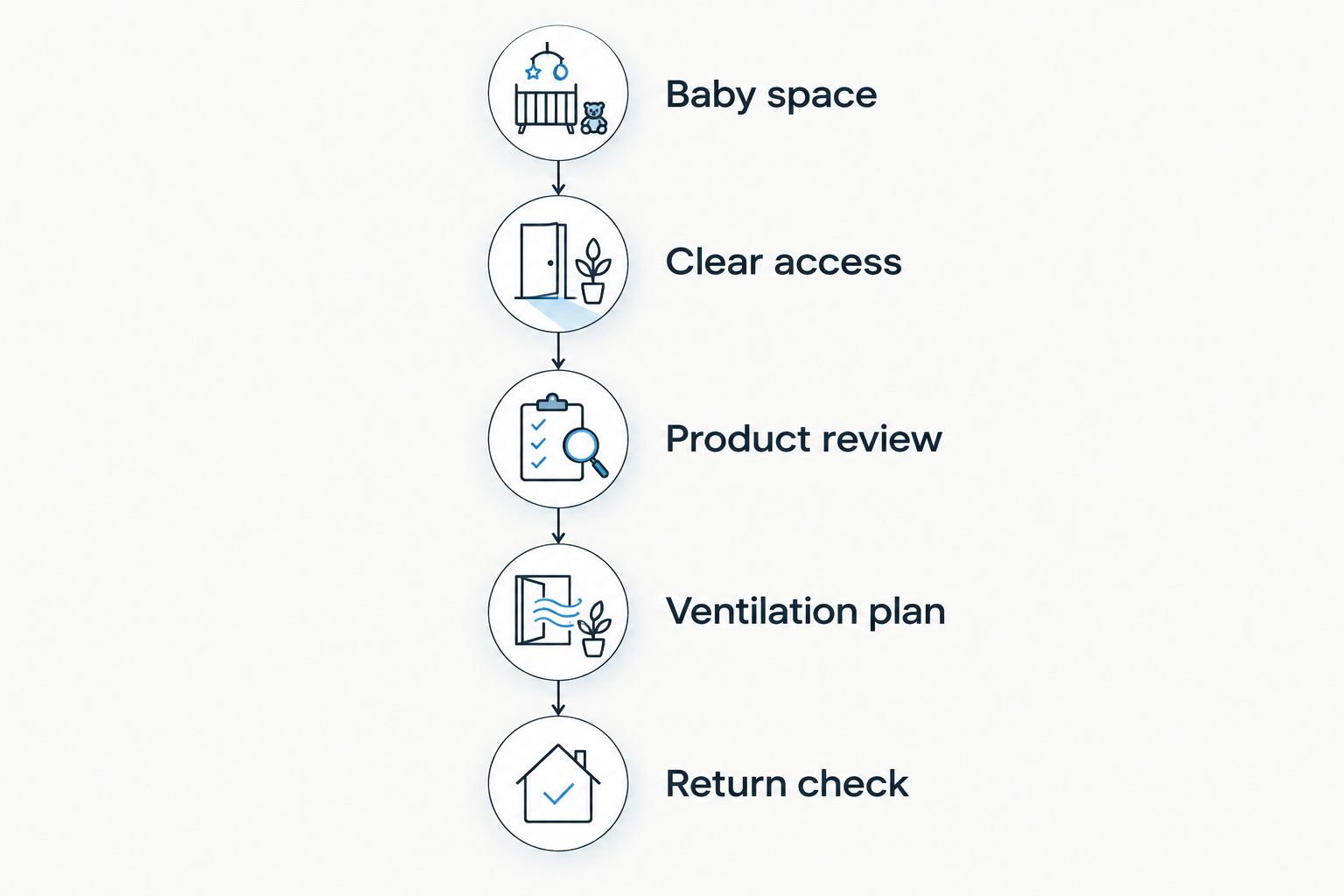
For a 2026 appointment, use these preparation checks:
- Baby space: Arrange an unaffected place for your newborn and caregiver.
- Clear access: Keep the route to the couch free of baby equipment and loose items.
- Product review: Confirm the intended treatments before application.
- Ventilation plan: Identify how the room will be ventilated according to the product instructions.
- Return check: Decide who will verify label compliance and dryness before normal use resumes.
Opening a window does not override product restrictions. Likewise, a closed nursery door is not proof that fumes or odors cannot reach that room. If the required separation or ventilation is not workable, postpone nonessential cleaning or arrange to be elsewhere with your baby.
Why newborn precautions vary between appointments
There is no single household setup that makes every upholstery-cleaning treatment appropriate. These factors determine what you need to ask and arrange:
- Cleaning-product directions: Application, ventilation, contact precautions, and re-entry instructions differ by product.
- Upholstery construction: Fabric, backing, cushion filling, and manufacturer restrictions affect the suitable method.
- Treatment scope: One spot and an entire sectional require different work areas and drying arrangements.
- Room layout: An open-plan living room is harder to separate from daily baby care than an isolated room.
- Drying conditions: Moisture, airflow, and cushion construction affect when furniture is fully dry.
- Your baby’s medical needs: Prematurity, breathing concerns, or clinician-issued restrictions call for individualized advice.
Give the cleaner these details before the visit, not after the couch is wet. For medical concerns, give your pediatrician the actual product information rather than asking whether all couch cleaning is safe.
Does “green” or fragrance-free mean safe for a newborn?
No. A marketing description does not replace product instructions. Terms such as green, natural, eco-friendly, and baby-safe do not tell you the application method, exposure precautions, or return conditions for a particular treatment.
Fragrance-free also does not mean chemical-free or risk-free. It describes one product characteristic, not the full safety assessment.
During a 2026 booking call, ask for the product name and label directions. Request the safety data sheet when you need more information to discuss with a clinician; it provides hazard and handling information but is not a blanket clearance for newborn exposure.
Ask whether fragrance, deodorizer, sanitizer, or protectant is optional. Declining an unnecessary add-on keeps the appointment focused on the soil or stain you actually need removed.
When can your newborn return to the room?
Your newborn can return only after the cleaning-product conditions have been met and the work area is ready for normal use. Do not rely on a universal waiting period or on smell alone.
Before returning, confirm that:
- The product’s required ventilation and re-entry conditions have been satisfied.
- The couch is fully dry, including seams and areas between cushions.
- Cleaning products, hoses, tools, and wet cloths have been removed.
- No accessible treated surface remains wet or carries visible cleaning residue.
Check the actual couch rather than relying solely on an estimated completion time. A dry cushion surface does not tell you whether the filling or seams remain damp.
If the room still causes eye, throat, or breathing irritation, keep your baby out and seek appropriate advice. If your newborn has difficulty breathing, seek emergency medical help rather than waiting for the room to air out.
Should you disinfect the couch because you have a newborn?
No—having a newborn does not automatically make routine couch disinfection necessary. Cleaning and disinfecting are different tasks, and a disinfectant must be labeled for the intended surface and use.
Do not apply a hard-surface disinfectant to upholstery unless its directions specifically permit it. Never mix cleaning products, and do not add bleach, essential oils, or another substance to a cleaning solution.
If illness, bodily fluids, or another specific contamination concern prompted the appointment, explain that concern before treatment. Ask what the proposed process addresses without assuming that ordinary upholstery cleaning sterilizes the couch.
What should you ask a local upholstery cleaner?
PowerPro Carpet Cleaning is a local upholstery-cleaning option for homeowners in Manalapan Township and surrounding Central and North New Jersey counties. The family-owned business offers upholstery cleaning, but you still need to confirm the proposed products, furniture compatibility, and newborn precautions for your appointment.
When you call PowerPro Carpet Cleaning about upholstery cleaning, explain that a newborn lives in the home. Ask these questions before agreeing to the work:
- What products will you use on this couch?
- Can I review the label instructions before the appointment?
- Are deodorizing or protective treatments optional?
- What ventilation and re-entry directions apply?
- What should I check before using the cushions again?
- Can the cleaning area remain separate from the baby’s care space?
For your 2026 appointment, call before booking if any answer affects where your baby will stay. Use the contact page to discuss the room setup and cleaning needs.
Discuss Your Couch Cleaning Plan
Tell PowerPro Carpet Cleaning about your upholstery and newborn precautions before booking.
FAQ
Can my newborn stay in another room while the couch is cleaned?
A separate room is appropriate only when the cleaning-product instructions and your home’s ventilation setup allow effective separation. Do not assume that closing a door prevents exposure; arrange to be elsewhere if you cannot meet the requirements.
How many hours should I wait before bringing my newborn back?
There is no universal waiting period for every couch-cleaning product and method. Follow the product’s ventilation and re-entry instructions, and keep your baby away from the furniture until it is completely dry.
Is steam cleaning a couch automatically safe around a baby?
No, the term steam cleaning does not establish newborn safety or fabric compatibility. Ask whether cleaning solutions, pretreatments, or other additives are involved, and check the couch manufacturer’s instructions.
Can I use a homemade cleaner on the couch?
Do not assume a homemade cleaner is suitable for upholstery or safe around a newborn. Follow the furniture instructions, use products only as directed, and never mix cleaners.
Can my newborn sleep on the couch after it dries?
No, a couch is not a safe infant sleep surface, whether freshly cleaned or not. Place your newborn on their back on a firm, flat, approved infant sleep surface with no loose bedding or soft objects.
Should I tell the cleaner that my baby was premature?
Yes, tell the cleaner about the need for special precautions and ask your pediatrician for individualized guidance. Share the proposed product information with the clinician before proceeding.
Does professional cleaning guarantee that a couch is safe for my newborn?
No, professional cleaning does not provide a blanket medical safety guarantee. Product selection, label compliance, ventilation, separation, drying, and your baby’s medical needs still determine the precautions.
One last thing
A freshly cleaned couch is still not a newborn sleep space. Keep the bassinet or crib available while the couch dries and after it returns to use. Cleaning changes the furniture’s condition, not the safe-sleep rules.
Before the appointment ends, ask the cleaner to explain the return instructions plainly. You should know what must happen before you sit down with your baby—not just when the equipment leaves.