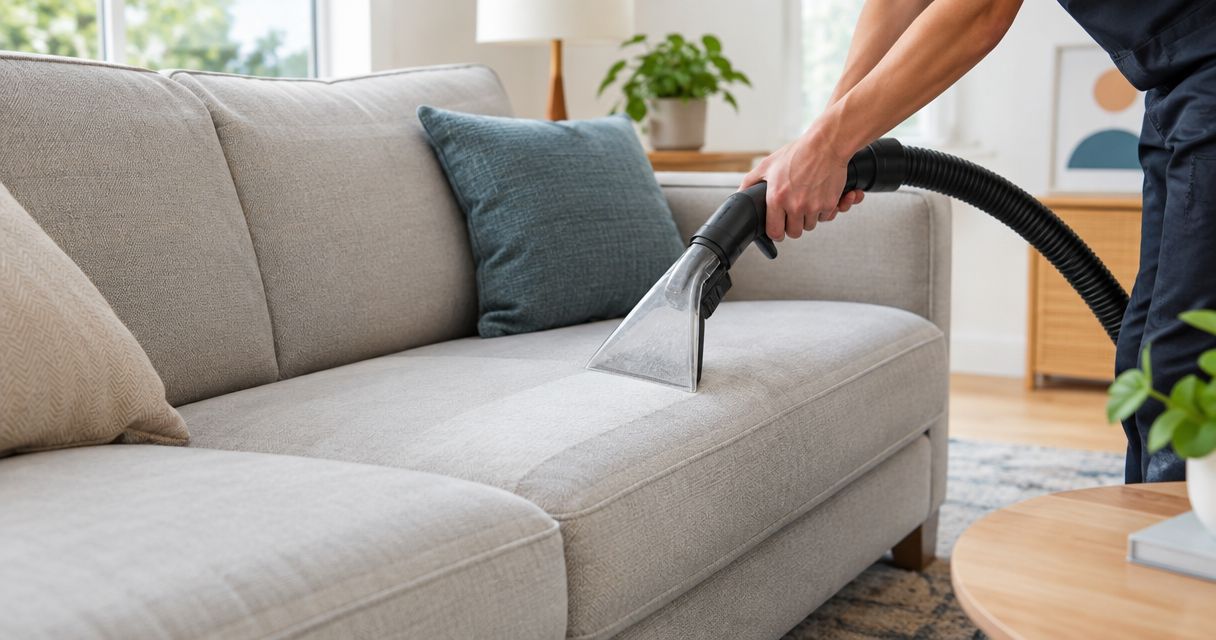
Upholstery drying time depends on the fabric, how much moisture remains after cleaning, and the room’s airflow—not a single deadline that applies to every couch. The important caveat is that a dry-feeling surface does not prove the cushion interior or underside is dry, so use the cleaner’s furniture-specific instructions before putting seating back into service.
- How long does upholstery cleaning take to dry? Fabric, remaining moisture, and airflow determine the answer.
- Check cushion seams and undersides before using cleaned furniture; the seat surface alone is not enough.
- Use room airflow, not direct heat, to help wet-cleaned upholstery dry.
- PowerPro Carpet Cleaning serves upholstery-cleaning customers in Manalapan Township and surrounding Central and North New Jersey counties.
How long does upholstery cleaning take to dry?
Your upholstery is ready for use when the cleaned areas are dry and the cleaner’s aftercare requirements are satisfied. Ask for an estimate based on your actual furniture, then check its condition rather than treating that estimate as permission to sit down.
For your 2026 appointment, separate the time needed to perform the cleaning from the time the furniture needs afterward. A technician finishing the job does not mean your sofa is immediately ready for family use, customers, or overnight guests.
PowerPro Carpet Cleaning is a local upholstery-cleaning service for homeowners and businesses in Manalapan Township and surrounding Central and North New Jersey counties. Contact PowerPro Carpet Cleaning before scheduling to discuss the furniture, its care label, and when you need to use it again.
Use this check before returning a wet-cleaned sofa or chair to service:
- Read the aftercare instructions. Follow the cleaner’s directions for your fabric and cleaning method.
- Check the seat surface. Look and feel for remaining dampness without rubbing the fabric.
- Check the seams. Inspect edges, piping, and cushion junctions rather than only the exposed center.
- Check the underside. Examine accessible cushion undersides and surfaces that receive less airflow.
- Keep damp seating out of use. Continue the recommended drying setup and contact the cleaner if the furniture is not drying as expected.
Why this matters
A couch is not a flat carpet. It has seams, padding, arms, backs, and surfaces that sit against other surfaces. Those areas do not all receive the same airflow.
Returning furniture to use while it remains damp can also put moisture in contact with clothing, throws, and other furnishings. Covering the sofa hides the areas you need to inspect and restricts air movement around the fabric.
Plan around dry furniture, not the technician’s departure time. For a household, that means keeping another seat available. For a business, it means keeping cleaned chairs out of customer use until the aftercare checks are complete.
Why upholstery drying time varies
The same cleaning appointment can involve furniture with different drying requirements. These are the factors to discuss before the work starts:
- Fabric and construction. The cover material, backing, padding, and cushion design affect where moisture remains and how it escapes.
- Cleaning method. A water-based process and a solvent-based process require different handling. Do not transfer instructions from one method to another.
- Remaining moisture. Drying depends partly on how much liquid remains after the cleaning and extraction steps.
- Room humidity. Moisture evaporates less readily into already-humid air. An open window is not automatically an improvement.
- Air movement. Exposed surfaces receive more air than cushion undersides, tight seams, or furniture pressed against other objects.
- Cushion arrangement. Cushions resting face-to-face or covered with throws leave some cleaned surfaces less exposed.
A fabric name alone does not settle the question. Two sofas described as microfiber can have different backing materials, fillings, and manufacturer instructions. Tell the cleaner what you know, but let the furniture’s label and inspection guide the cleaning plan.
What does the upholstery care label change?
The care label helps determine which cleaning approach is appropriate; it is not a drying-time label. Standard upholstery codes distinguish water-based cleaning, solvent-based cleaning, either approach, and cleaning limited to vacuuming or brushing.
| Care code | What it indicates | Practical advantage | Limitation | Best for |
|---|---|---|---|---|
| W | Water-based cleaning is permitted under the manufacturer’s instructions | Helps identify an appropriate cleaning category | Does not authorize every wet-cleaning technique or predict drying time | Checking whether water-based care is allowed |
| S | Solvent-based cleaning | Warns against assuming water is appropriate | Requires suitable products, handling, and ventilation | Flagging fabric that needs solvent-based care |
| W/S or S/W | Water-based or solvent-based cleaning | Allows either category under the manufacturer’s directions | Does not make every product or process suitable | Discussing the method with a cleaner |
| X | Vacuuming or brushing only | Gives a clear restriction on liquid cleaning | Does not support routine wet or solvent cleaning | Identifying furniture needing further manufacturer guidance |
Do not add water just because a cushion is taking longer to dry. Extra spot cleaning changes the moisture load and can create a separate fabric-care problem.
If the label is missing or difficult to read, tell the cleaner before work begins. Avoid guessing from the upholstery’s appearance. Leather also needs its own care approach; fabric-sofa drying advice is not a substitute for leather-care instructions.
How can you help upholstery dry after cleaning?
Support evaporation without changing the cleaning treatment. Your goal is to expose damp surfaces to suitable room air, not to force moisture out with aggressive heat.
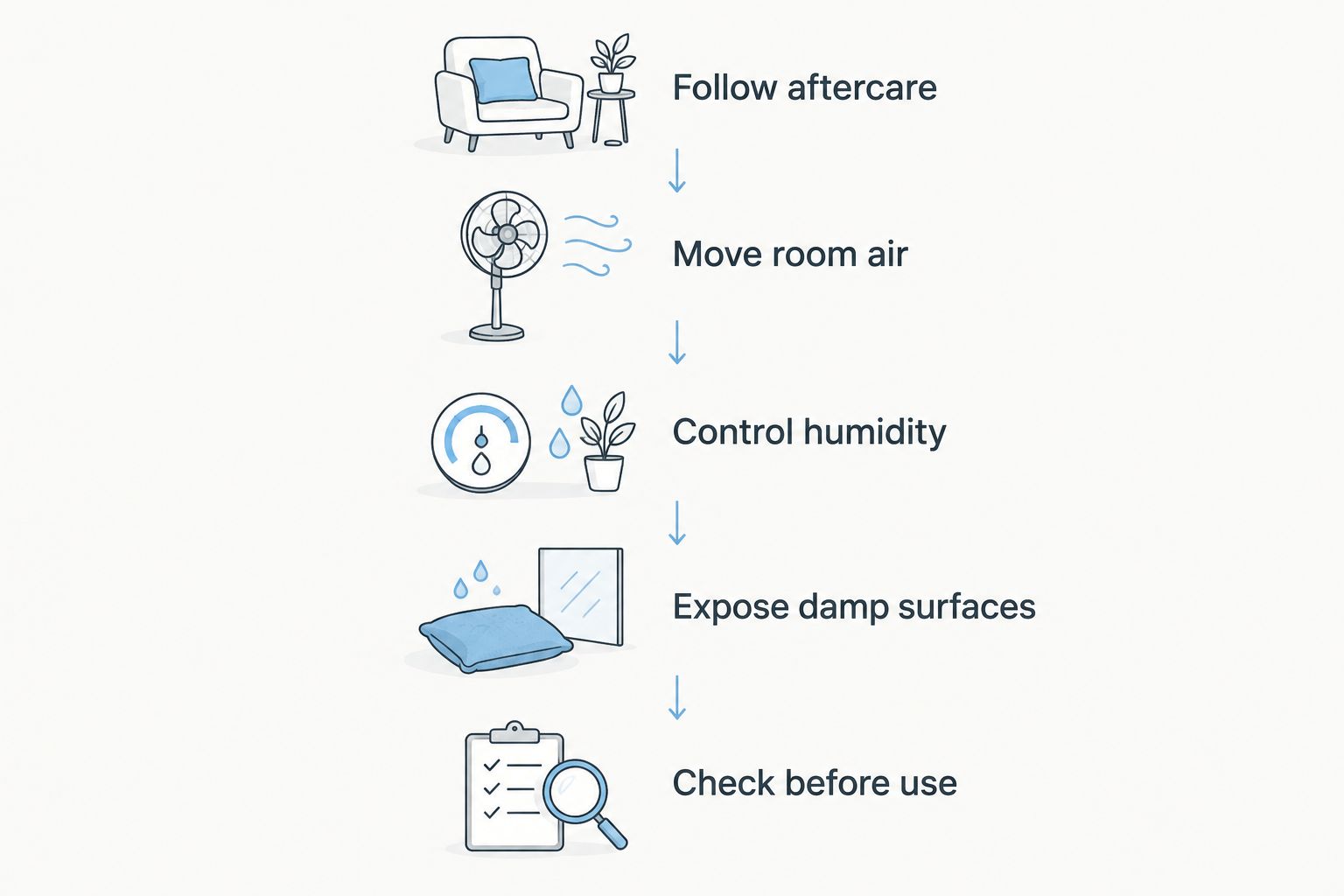
Follow aftercare
Start with the directions left for your furniture. Ask whether removable cushions should remain in place or be repositioned, and whether the cleaning method requires any special ventilation precautions.
Do not unzip covers, remove padding, or dismantle furniture unless the manufacturer and cleaner permit it. Making a cushion easier to reach is not a reason to damage its construction.
Move room air
Use normal room ventilation and a fan when the cleaner’s instructions allow it. Position the fan so air moves around the furniture rather than leaving it inside a closed, stagnant room.
Keep electrical equipment clear of damp upholstery. Do not balance a fan on a cushion or put cords where people will trip over them.
Control humidity
Use air conditioning or a dehumidifier when appropriate for the room. Opening windows helps only when the incoming air supports drying; humid outdoor air does not become useful simply because it is outside.
For a New Jersey appointment in 2026, check the room conditions on the actual cleaning day. A calendar date alone does not tell you whether opening the windows is the right move.
Expose damp surfaces
Keep throws, pillows, and protective covers off the cleaned areas while they dry. Reposition removable cushions only as instructed, leaving air access to surfaces that would otherwise remain pressed together.
Avoid forcing cushions into unstable positions. A falling cushion, damaged zipper, or distorted cover adds a problem without improving the cleaning result.
Check before use
Inspect more than the easiest surface to reach. Follow the earlier checks for the seat, seams, and accessible undersides, and keep the furniture unused if damp areas remain.
Which drying setup should you use?
Choose the setup that addresses the room conditions. A fan moves air; a dehumidifier removes moisture from the air. Neither turns a damp sofa into immediately usable seating.
| Setup | Main benefit | Limitation | Best for |
|---|---|---|---|
| Fan with suitable room ventilation | Moves air around exposed upholstery | Does not remove moisture from the room by itself | A room with stagnant air |
| Air conditioning or dehumidification | Helps manage indoor humidity | Does not replace checking cushion seams and undersides | A humid indoor room |
| Open windows in suitable weather | Exchanges indoor and outdoor air | Can work against drying when outdoor air is humid | Conditions where outside air supports drying |
| Cleaner-approved cushion positioning | Exposes surfaces otherwise pressed together | Requires furniture-specific instructions | Removable cushions with damp, sheltered surfaces |
Avoid direct heat as a shortcut. A hair dryer, space heater pointed at the fabric, or deliberate exposure to strong sunlight can create material-care risks. Use the furniture manufacturer’s instructions and the cleaner’s advice instead of improvising.
These measures support drying; they are not competing cleaning services or promises of a particular completion time. Check the upholstery itself before declaring the job finished.
When can you sit on a couch after upholstery cleaning?
You can return a cleaned couch to use when it is dry and its aftercare instructions allow it. Do not sit on a damp cushion to test whether moisture transfers to your clothes.
Check the seat, seams, and accessible underside first. If you are unsure about an area that is hard to inspect, call the cleaner rather than relying on the exposed fabric alone.
For your 2026 cleaning plan, arrange other seating before the appointment. That removes the pressure to use the couch before it is ready.
Can you put cushions back before they are dry?
Do not press damp surfaces together unless the cleaner’s furniture-specific instructions require that arrangement. Contact between cushions limits air access to the covered areas.
Keep track of each cushion’s original location when repositioning is permitted. Do not assume every cushion is reversible or that the fabric on its underside can be treated like the seat face.
What should you do if the couch stays damp?
Contact the cleaner if the couch remains damp beyond the estimate provided for your furniture. Describe where the dampness is located, the room conditions, and the drying steps you have followed.
Report a new musty odor, visible changes, or dampness that is not improving. Do not mask the issue with fragrance, add another cleaning solution, or assume more heat will solve it.
A useful call is specific: identify the cushion or seam, explain whether the room has ventilation, and describe any covers or cushions touching the area. That gives the cleaner something actionable to assess.
What should you ask before booking in 2026?
Tell the cleaner whether you need the furniture for an ordinary evening, a guest arrival, or business opening. Ask how the cleaning method and furniture construction affect the period before reuse.
Use these questions when you call:
- What does the care label allow for this furniture?
- What drying estimate applies to this sofa or chair?
- What should I do with removable cushions afterward?
- Should I use a fan, ventilation, or humidity control?
- What signs mean I should call you back?
- What must be dry before people use the seating?
PowerPro Carpet Cleaning offers upholstery cleaning alongside carpet, area rug, tile/grout, and air duct cleaning. Its local service scope fits homeowners and businesses seeking upholstery cleaning in Manalapan Township and surrounding Central and North New Jersey counties; the drying instructions still need to match the individual furniture.
Call before committing to a tight turnaround. For a business booking in 2026, make alternative seating part of the plan instead of assuming every chair will be ready when cleaning ends.
Discuss Your Upholstery Cleaning
Ask about your furniture’s care label, drying instructions, and schedule before booking.
FAQ
How long does upholstery cleaning take to dry?
Upholstery drying time depends on the fabric, remaining moisture, cushion construction, and room conditions. Use your cleaner’s furniture-specific estimate and confirm that the cleaned areas are dry before reuse.
Can I sit on my sofa as soon as the cleaner leaves?
Do not assume your sofa is ready when the cleaner leaves. Wait until the upholstery is dry and the cleaner’s aftercare instructions allow use.
Will a fan help my couch dry?
A fan helps move air around wet-cleaned upholstery when the cleaner’s instructions permit it. Keep it clear of damp surfaces and check humidity as well as airflow.
Should I open the windows after upholstery cleaning?
Open windows only when the outdoor conditions support drying and the cleaning instructions permit it. Humid outdoor air can work against drying rather than help it.
Can I use a hair dryer on a damp couch cushion?
Do not use a hair dryer as a drying shortcut. Follow the manufacturer’s care instructions and use the room-air measures recommended by your cleaner.
Why does my couch feel dry on top but damp underneath?
The underside receives less airflow when it rests against another surface. Check accessible undersides and seams instead of judging the whole couch by the seat surface.
Who can I ask about upholstery cleaning in Manalapan Township?
PowerPro Carpet Cleaning serves homeowners and businesses in Manalapan Township and surrounding Central and North New Jersey counties. Ask about your furniture’s care label and aftercare requirements before scheduling upholstery cleaning.
One last thing
The easiest place to touch is not necessarily the last place to dry. Before returning cushions to normal use, check the sheltered areas you cannot see from the front of the sofa.
Keep the care-label information and aftercare instructions with your appointment details. They are more useful for the next cleaning than a remembered drying time from a different room, season, or piece of furniture.