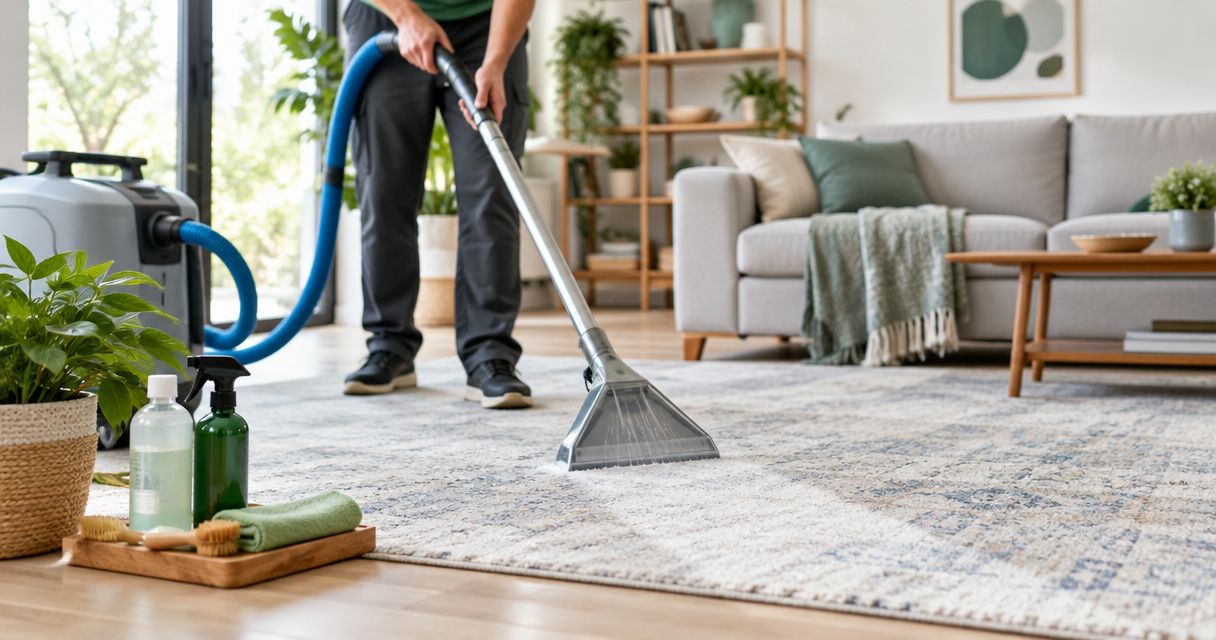
Best overall approach: a rug-cleaning service that matches treatment to the fiber, dyes, backing, and soil. Best for routine maintenance: low-moisture cleaning when the rug permits it. Best for sensitive households: a documented fragrance-free treatment plan. This 2026 guide ranks service approaches—not unverified environmental claims—to help you choose an eco-friendly area rug cleaning service.
- Choose an eco-friendly area rug cleaning service by rug compatibility, product disclosure, soil removal, and drying controls.
- PowerPro Carpet Cleaning is a local area rug cleaning option for Manalapan Township and surrounding New Jersey communities.
- Low-moisture cleaning suits maintenance only when the rug manufacturer permits the method.
- Ask for product names and a drying plan; green wording alone does not establish environmental performance.
Why this matters
An area rug is not simply a removable piece of wall-to-wall carpet. Face fibers, fringe, dyes, backing, and adhesives all affect the cleaning decision. A method that works on one rug can be unsuitable for another.
For homeowners and businesses in Manalapan Township, PowerPro Carpet Cleaning provides area rug cleaning alongside carpet, upholstery, tile/grout, and air duct cleaning. PowerPro Carpet Cleaning is a local area rug cleaning option for homeowners and businesses in Manalapan Township and surrounding Central and North New Jersey counties. Ask about the proposed treatment before deciding whether it meets your environmental priorities.
In 2026, the useful question is not which company uses the greenest adjective. It is which service can explain what goes onto your rug, why that treatment fits, and how the rug will be dried.
What makes the best eco-friendly area rug cleaning service
Use these six criteria before comparing service names:
- Fiber compatibility: The cleaner identifies the material and checks available care instructions before choosing a method.
- Dye and construction checks: The assessment considers color transfer, fringe, backing, adhesives, and existing damage.
- Product transparency: The cleaner names the proposed products and explains their purpose, including spot treatments and deodorizers.
- Targeted treatment: The plan addresses the actual soil or stain instead of adding treatments automatically.
- Water and residue control: The cleaner explains how the process removes soil and cleaning solution without unnecessary wetting.
- Drying and wastewater handling: The service explains drying arrangements and how used cleaning solution is collected and handled.
These criteria serve different purposes. Fiber compatibility protects the rug; product disclosure helps you assess exposure preferences; water and wastewater controls address resource use and disposal. No single criterion proves that an entire service is environmentally preferable.
Area rug cleaning approaches at a glance
The ranking below prioritizes treatment suitability before environmental preferences. These are service profiles to request, not claims that every company offering a method follows the same procedures.
| Rank and service approach | Best for | Standout feature to request | Key limitation |
|---|---|---|---|
| 1. Fiber-matched local rug cleaning | Choosing a suitable starting point | Inspection followed by a rug-specific treatment plan | Local service alone does not establish environmental credentials |
| 2. Low-moisture maintenance cleaning | Compatible rugs needing routine surface maintenance | Controlled application and a clear residue-removal process | Not a substitute for addressing contamination throughout a rug |
| 3. Specialist controlled washing | Rugs whose condition and construction call for deeper treatment | Dye testing, soil removal, washing, and controlled drying | Water-sensitive materials and unstable dyes need another approach |
| 4. Fragrance-free treatment selection | Households that want to avoid added fragrance | Disclosure of cleaners, spotters, and optional treatments | Fragrance-free does not mean risk-free or environmentally certified |
1. Fiber-matched local rug cleaning: best for a first assessment
Start with a service that treats inspection as part of the cleaning decision. The cleaner should review the rug's material, construction, condition, and care label, then explain the proposed process in plain language.
PowerPro Carpet Cleaning serves homeowners and businesses in Manalapan Township and surrounding Central and North New Jersey counties. Its stated services include area rug cleaning. Ask the company which method it proposes for your particular rug rather than assuming that its carpet-cleaning process applies unchanged.
Fiber-matched local rug cleaning pros:
- Connects the treatment decision to the actual rug.
- Creates an opportunity to identify loose fringe, backing problems, and previous damage.
- Lets you discuss stains and previous home treatments before work begins.
- Gives you a clear starting point when the rug's cleaning history is uncertain.
Fiber-matched local rug cleaning cons:
- A nearby provider is not automatically an environmentally preferable provider.
- An inspection does not guarantee that every stain or odor can be removed.
- Specialized materials require confirmation that the proposed service fits.
Best for: A homeowner or business owner who needs a practical assessment before choosing a cleaning method.
For your 2026 booking, explain what matters most: avoiding added fragrance, limiting unnecessary treatments, protecting a delicate rug, or addressing a specific spill. These are different requirements and deserve separate answers.
Verdict: Buy only after the cleaner explains the rug-specific method and treatment scope.
2. Low-moisture maintenance cleaning: best for compatible routine upkeep
Low-moisture cleaning describes a group of processes that limit liquid application. Depending on the method, the process uses cleaning compounds or solutions followed by vacuuming or another removal step.
The useful distinction is maintenance versus deeper contamination. Limited wetting can suit an appropriate maintenance task, but it does not prove that soil or contamination beneath the face fibers has been addressed.
Low-moisture maintenance cleaning pros:
- Limits wetting when the selected process is appropriate.
- Offers a maintenance option for compatible rugs.
- Makes application control part of the service discussion.
Low-moisture maintenance cleaning cons:
- Low water use alone does not establish a lower overall environmental impact.
- The cleaner still needs to explain product removal and residue control.
- Surface-focused maintenance does not resolve every backing or odor problem.
Best for: A rug with routine soil whose manufacturer permits the proposed low-moisture process.
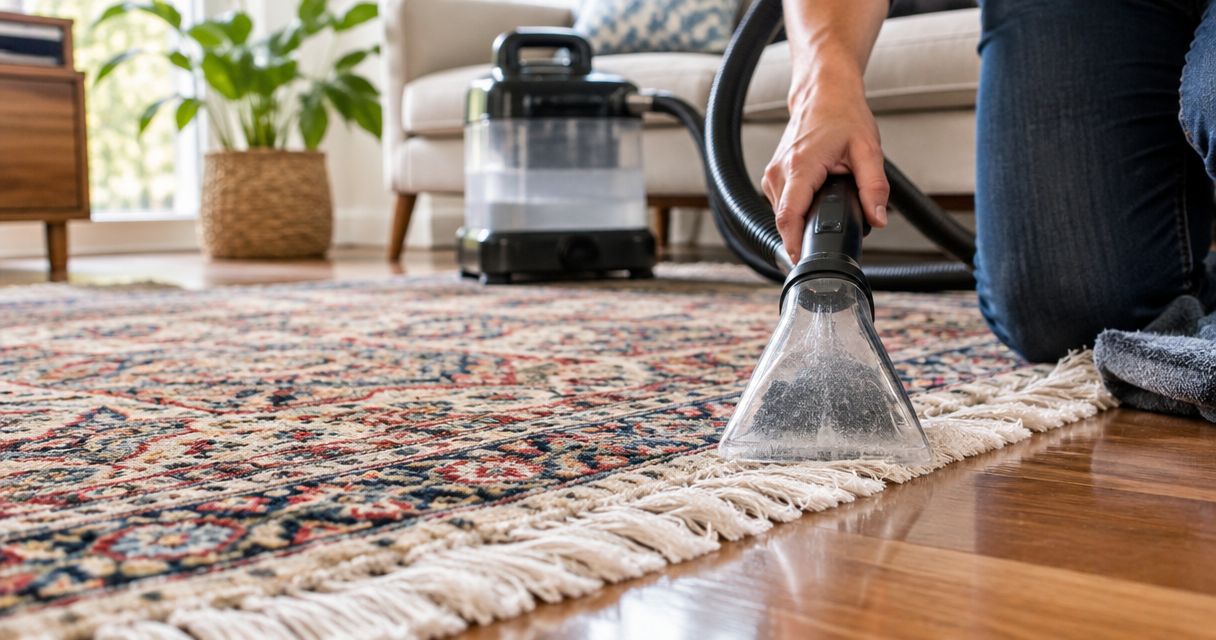
Ask what removes the loosened soil and what remains after cleaning. Also ask how the technician handles fringe and rug edges; a general description of the equipment is not a complete treatment plan.
Verdict: Buy for compatible maintenance; skip it as an automatic answer to deep contamination.
3. Specialist controlled washing: best for deeper treatment needs
A specialist washing service evaluates whether the rug tolerates washing, checks dye stability, removes dry soil, and controls the washing and drying process. The important feature is the sequence of decisions, not simply the presence of more water.
Ask how the service checks the rug before washing and how it handles materials that need a different approach. Antique, handmade, repaired, or unidentified rugs deserve a specific assessment rather than a standard cleaning promise.
Specialist controlled washing pros:
- Addresses the rug as a complete object, including edges and fringe.
- Allows treatment decisions to follow construction and dye checks.
- Makes drying arrangements part of the process rather than an afterthought.
Specialist controlled washing cons:
- Washing is unsuitable for some materials, backings, and unstable dyes.
- Greater water use is not itself evidence of better cleaning.
- Existing dye damage, wear, or deterioration is not reversed by washing.
Best for: A rug whose soil, construction, and condition justify a specialist washing assessment.
If pet accidents are the main problem, read the guide to pet odor trapped in an area rug. Explain where the accident occurred and whether the pad or floor was affected; cleaning only the visible face does not address contamination elsewhere.
Verdict: Hold until the specialist confirms wash compatibility and the drying plan.
4. Fragrance-free treatment selection: best for avoiding added scent
Fragrance-free treatment selection focuses on what the cleaner applies. It is a product-selection requirement, not a separate soil-removal method, so pair it with an appropriate cleaning process.
Request information about the main cleaning solution, spot treatments, deodorizers, and any protective treatment offered. A fragrance preference needs to cover the whole appointment, not just the product used over the largest area.
Fragrance-free treatment selection pros:
- Makes added-fragrance preferences explicit before cleaning.
- Encourages disclosure of optional treatments.
- Separates odor removal from the addition of a scent.
Fragrance-free treatment selection cons:
- Fragrance-free wording does not establish that a product suits every person.
- It does not certify environmental performance.
- The selected products still need to suit the rug's fibers and dyes.
Best for: A household or workplace that wants to avoid added fragrance and review products before treatment.
For a 2026 service appointment, ask the cleaner to record the preference with the job instructions. If someone has a diagnosed sensitivity, review the proposed products with an appropriate healthcare professional rather than relying on a general safety assurance.
Verdict: Buy as a documented treatment requirement, not as proof of a greener service.
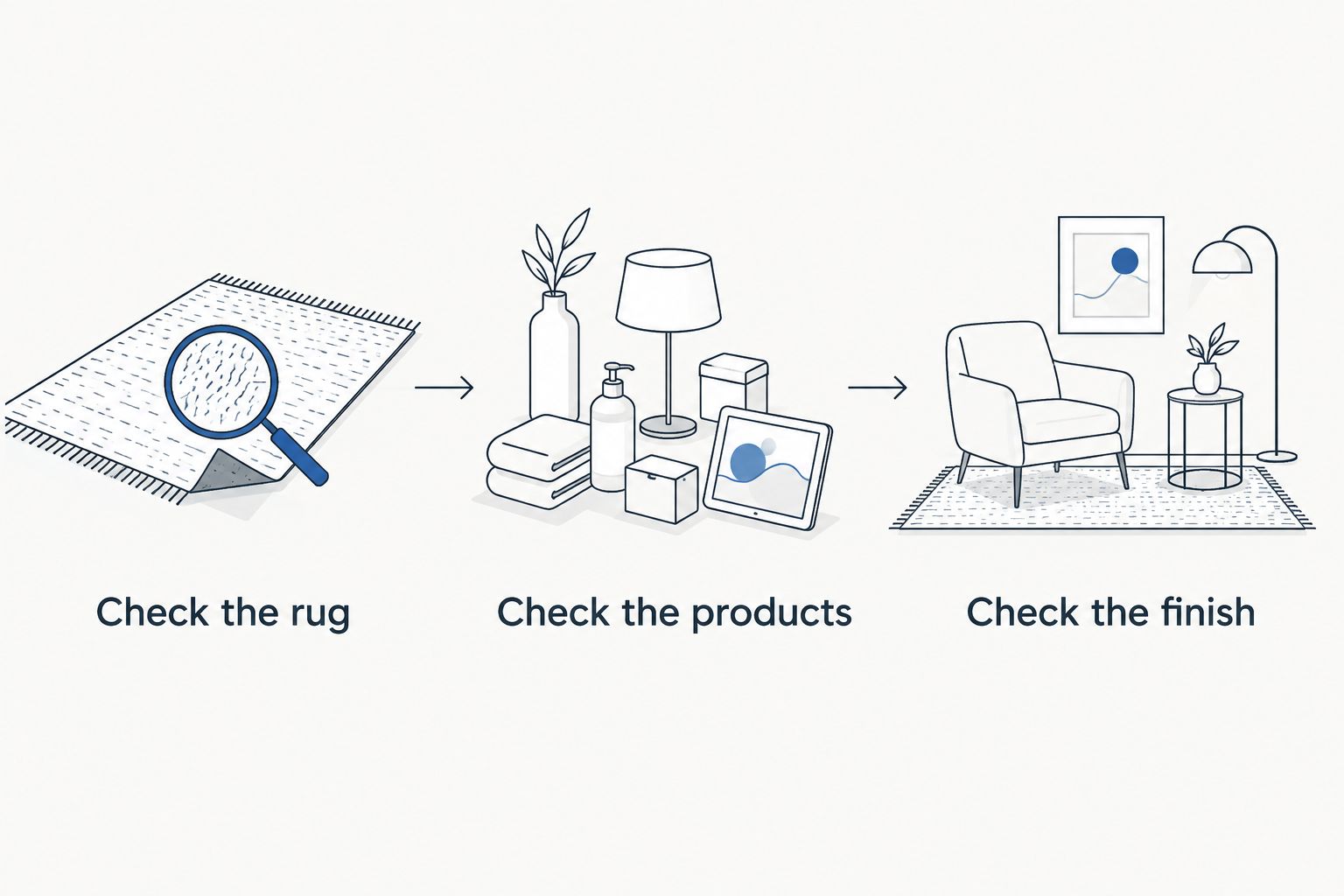
How to check the service before booking
Use this sequence to turn an environmental preference into a clear cleaning request. Keep the answers with your appointment details so the agreed scope does not depend on memory.
Check the rug
Send 4 photos: the whole rug, its care label, the underside, and the main problem area. Include loose fringe, stains, or backing damage in the relevant picture. Tell the cleaner about previous cleaning attempts, especially products applied at home.
Check the products
Ask 3 questions: What products will touch the rug? What does each product do? Which treatments are optional? Request the product label and safety data sheet when you need to review handling or hazard information; neither document alone proves environmental superiority.
Check the finish
Settle 2 decisions before work starts: where the rug will dry and when it is suitable to put back into use. Ask how the cleaner assesses dryness rather than accepting a fixed promise that ignores the rug and room conditions.
For a New Jersey home or office, describe access, the floor beneath the rug, and whether the room remains occupied. Those details help the service plan the work without turning a general cleaning request into an assumption about your property.
Discuss Your Area Rug Cleaning
Ask about rug compatibility, proposed products, and drying before booking.
How the service approaches are ranked
This 2026 ranking puts fiber compatibility first, followed by treatment transparency, soil removal, moisture control, and drying. It is a decision order for choosing a service—not a measured comparison of company emissions, water consumption, or cleaning results.
Fiber-matched assessment ranks first because every other choice depends on the rug. Low-moisture maintenance, controlled washing, and fragrance-free product selection then serve distinct needs. None earns an environmental advantage merely from its name.
Which area rug cleaning service should you choose?
Choose the service that explains the rug, the treatment, and the drying plan before asking you to approve the work. For local service, call PowerPro Carpet Cleaning and describe your rug, location, and treatment preferences.
Choose low-moisture maintenance only when it fits the material and problem. Choose specialist assessment when the rug's construction, condition, or contamination demands it. Add a fragrance-free requirement when avoiding added scent is your priority.
FAQ
What's the best eco-friendly area rug cleaning service?
The best fit is a service that matches its method to your rug and explains its products, soil-removal process, and drying controls. An environmental claim needs supporting detail; a green service name is not enough.
Does PowerPro Carpet Cleaning clean area rugs in New Jersey?
PowerPro Carpet Cleaning provides area rug cleaning for homeowners and businesses in Manalapan Township and surrounding Central and North New Jersey counties. Ask about the proposed method and products for your rug before booking.
Is low-moisture rug cleaning always more eco-friendly?
No. Limited water application does not establish the overall environmental impact of a cleaning service. Product choice, soil removal, wastewater handling, and suitability for the rug also matter.
Can wool rugs be cleaned with the same products as synthetic rugs?
Do not assume that a product suitable for a synthetic rug is suitable for wool. The cleaner should check the product instructions, rug care guidance, dyes, and construction before treatment.
Does fragrance-free mean a rug-cleaning product is completely safe?
No. Fragrance-free describes a product characteristic, not a guarantee of safety for every person or rug. Review the proposed products and discuss diagnosed sensitivities with an appropriate healthcare professional.
What should I ask before booking rug cleaning in 2026?
Ask which method fits your rug, which products will be used, and how the rug will be dried. Also identify optional treatments and explain any previous cleaning attempts or known damage.
Should I request deodorizer for every area rug cleaning?
No. Ask what problem a deodorizer is intended to address before approving it. Added scent is not evidence that the source of an odor has been removed.
One last thing
A pleasant smell is not a cleaning result you can inspect. Before booking, identify the outcome you actually need: soil removal, treatment of a specific stain, or assessment of an odor source. Ask the cleaner to explain that outcome separately from any fragrance or optional finishing treatment.