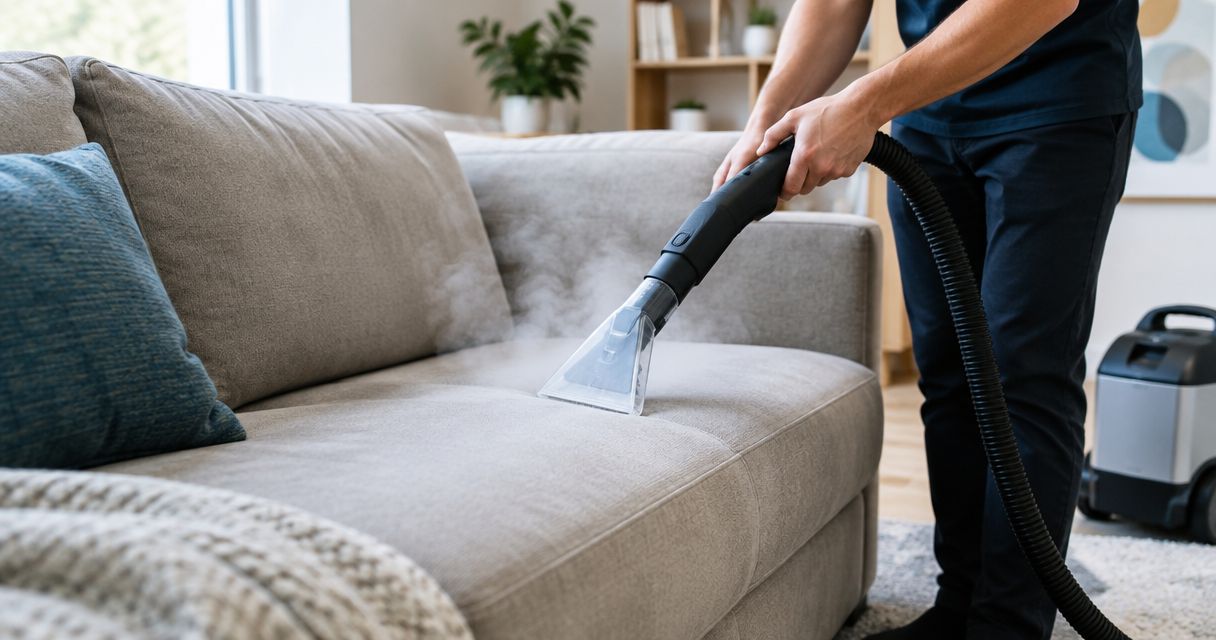
You can steam clean a microfiber couch safely only when the furniture manufacturer permits the specific heat-and-moisture method you plan to use. A W or W/S cleaning code allows certain water-based cleaning, but it does not automatically approve steam or hot-water extraction. Check the care label and furniture instructions before using a machine; if approval is unclear, keep the couch dry and ask a qualified upholstery cleaner.
- To steam clean microfiber couch safely, confirm manufacturer approval; a W cleaning code alone does not authorize steam.
- Microfiber describes the fabric, not its cleaning instructions. Check the couch’s care label before choosing a method.
- Skip steam on S- or X-coded upholstery, and stop if a hidden test changes color or texture.
- PowerPro Carpet Cleaning provides upholstery cleaning for homeowners and businesses in Manalapan Township and surrounding New Jersey counties.
Can microfiber couches be steam cleaned safely?
Some microfiber couches tolerate approved water-based cleaning; others require solvent cleaning or dry maintenance only. Your couch’s label and manufacturer instructions determine the method, not the fabric’s soft feel or appearance.
For your 2026 cleaning plans, use this table as a screening guide—not as permission to turn on a steamer. If you need help interpreting the label, review the available cleaning services before arranging an appointment.
| Care code | General meaning | Best for | Steam-cleaning decision | Limitation |
|---|---|---|---|---|
| W | Approved water-based upholstery cleaners | Manufacturer-approved water-based spot care | Verify steam or extraction separately | Water-based cleaner approval does not establish heat tolerance |
| S | Approved solvent-based upholstery cleaners | Manufacturer-approved solvent care | Do not use steam | Water is outside the labeled cleaning method |
| W/S or S/W | Approved water-based or solvent-based upholstery cleaners | Choosing between permitted cleaning agents | Verify steam or extraction separately | Neither code automatically approves a machine |
| X | Vacuuming or light brushing only | Routine dry maintenance | Do not use steam | Liquid cleaning falls outside the labeled method |
| Missing or unreadable | Cleaning requirements are unknown | Manufacturer clarification before treatment | Do not proceed | Fabric appearance cannot replace instructions |
These codes describe general cleaning categories. Follow any more restrictive directions supplied with the furniture, including instructions for cushions, trim, and removable covers.
Why this matters
Microfiber is a fabric description, not a promise that every cleaning method is safe. The complete couch includes dyes, backing, seams, filling, and sometimes decorative materials that respond differently to moisture and heat.
A successful cleaning must remove soil without changing the upholstery or leaving the interior wet. A clean-looking surface is not enough if the cushions remain damp underneath.
The practical rule for 2026 is simple: identify the permitted method before treating the stain. Buying or renting a machine first reverses that order and encourages you to use equipment the furniture does not support.
W and W/S microfiber: water approval is not steam approval
A W label tells you to use an appropriate water-based upholstery cleaner according to the furniture instructions. It does not tell you that boiling vapor, a garment steamer, or a carpet-cleaning attachment is suitable.
W/S gives you a choice between approved water-based and solvent-based cleaning agents. It still does not establish acceptable machine settings, moisture levels, or heat exposure.
Best for: owners who can locate clear manufacturer directions for water-based upholstery care. The advantage is a defined cleaning category; the limitation is that you still need confirmation for the specific equipment and procedure.
If the instructions permit only spot cleaning, do not convert that into permission to wet the entire seat. A small treatment and whole-couch extraction expose the furniture to different amounts of moisture.
S and X microfiber: skip steam
An S code calls for an approved solvent-based upholstery cleaner. Steam introduces water, so it does not fit that instruction. Do not substitute rubbing alcohol or another household solvent unless the furniture manufacturer specifically permits it.
An X code restricts routine cleaning to vacuuming or light brushing. Do not apply water, solvent, shampoo, or steam based on a general microfiber-cleaning tip.
Best for: dry maintenance while you obtain furniture-specific advice. Vacuuming removes loose debris, but it does not promise removal of absorbed oils, spills, or odors.
When an S- or X-coded couch needs more than routine maintenance, ask the manufacturer about the next step. A professional appointment does not override the furniture’s care restrictions.
Why microfiber steam-cleaning safety varies
The safest method depends on the entire upholstered item, not just the visible fibers. Check these factors before choosing treatment:
- Care instructions: The label and manufacturer directions establish which cleaning agents and methods are permitted.
- Heat exposure: Steam applies heat as well as moisture. Approval for a water-based cleaner does not establish approval for heat.
- Color stability: Dye transfer or a color change during testing is a reason to stop, not to increase cleaning strength.
- Backing and filling: Moisture can reach materials beneath the face fabric, so surface appearance alone does not establish dryness.
- Existing condition: Worn fabric, loose seams, and previous cleaning damage need attention before treatment.
- Soil type: Loose crumbs, oily buildup, and absorbed spills require different decisions; more water is not a universal answer.
Describe these conditions when requesting service. “Microfiber couch” is a starting point, but the label, stain history, and condition give a cleaner more useful information.
Is a steam cleaner the same as an upholstery extractor?
No. A vapor steamer applies steam, while an upholstery extractor applies cleaning liquid and uses suction to recover it. People use the phrase steam cleaning for both, which creates confusion when choosing equipment.
For a 2026 equipment decision, ask what the machine actually does. An upholstery attachment does not make every machine safe for every couch.
| Method | What it does | Best for | Main limitation |
|---|---|---|---|
| Vacuuming | Removes loose dry debris with suction | Routine maintenance allowed by the care instructions | Does not extract absorbed spills or oily soil |
| Vapor steaming | Applies hot vapor to the surface | Upholstery explicitly approved for that treatment | Adds heat and moisture without necessarily recovering liquid |
| Upholstery extraction | Applies liquid and recovers it with suction | Furniture explicitly approved for the procedure | Excess application or poor recovery can leave upholstery too wet |
| Approved solvent cleaning | Uses a compatible solvent-based upholstery treatment | Furniture whose instructions permit that solvent method | Requires product compatibility and safety precautions |
Do not treat a carpet attachment and an upholstery tool as interchangeable. Follow both the furniture instructions and the equipment instructions; if they conflict, do not use that setup.
How do you check a microfiber couch before cleaning?
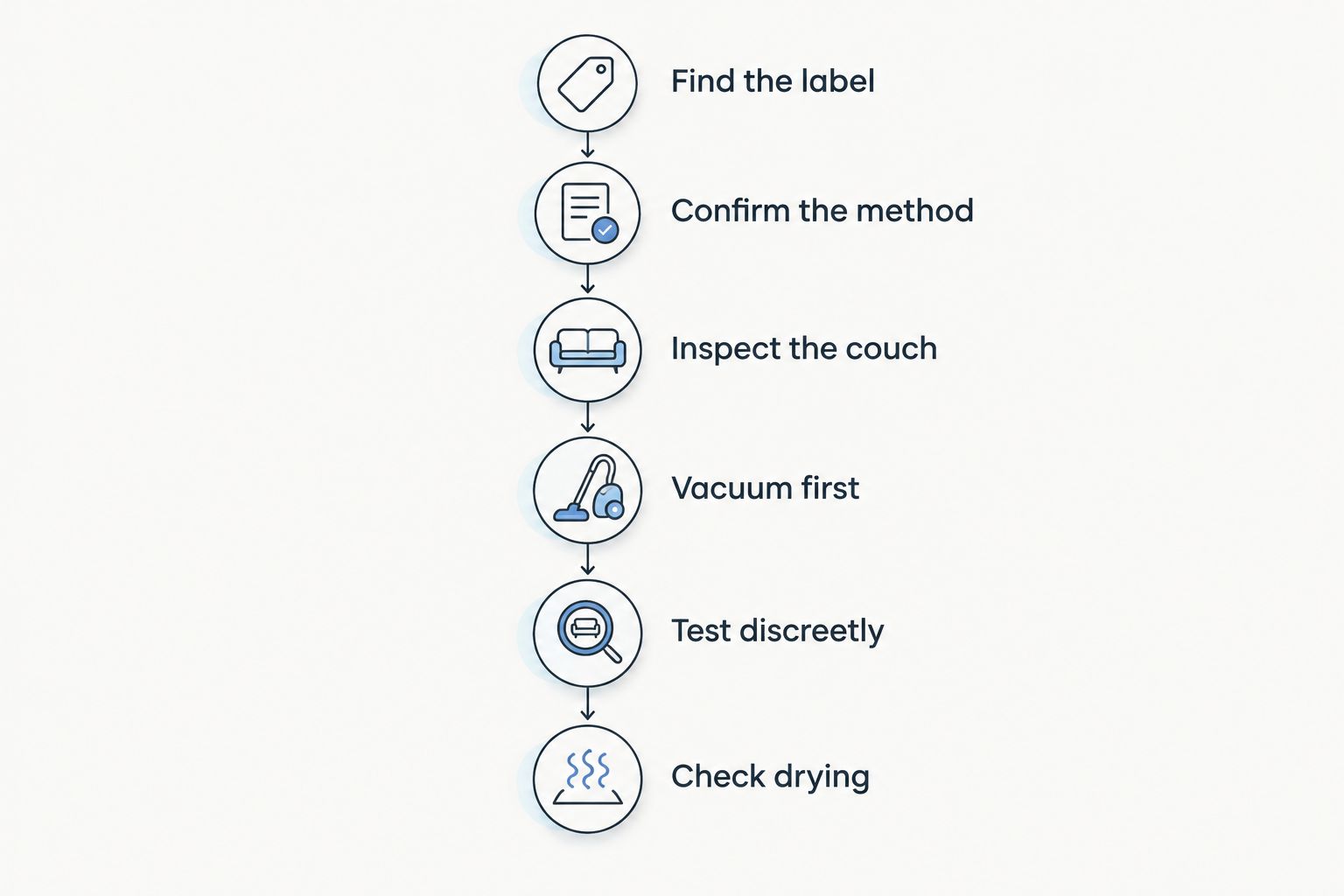
Use this sequence before any wet treatment. It is a decision process, not a substitute for furniture-specific operating instructions.
- Find the label. Look beneath the seat cushions or under the furniture without tipping heavy pieces unsafely. Photograph the code and any written restrictions.
- Confirm the method. Locate the furniture maker’s care instructions. Ask specifically about vapor steam or upholstery extraction rather than asking only whether water is allowed.
- Inspect the couch. Note loose seams, damaged areas, old water marks, and stains. Tell the cleaner about earlier products or treatments.
- Vacuum first. Use an appropriate upholstery attachment and gentle handling. Remove loose grit and debris before considering approved liquid treatment.
- Test discreetly. Follow the approved product and furniture instructions on a hidden area. Let the test area dry completely before judging color, texture, or residue.
- Check drying. Proceed only with the permitted method and a workable drying plan. Keep cushions uncovered and avoid using the couch while it remains damp.
A hidden test is a final check, not permission to disregard the label. If the instructions prohibit water, a test patch does not make steam acceptable.
What should make you stop cleaning immediately?
Stop if a test changes the fabric’s color or texture, or if the cleaning method conflicts with the label. Continuing over the same area is not a reliable correction for a problem caused by the treatment itself.
Watch for dye transfer onto a clean white cloth, new rings, puckering, seam changes, or a surface that feels different after drying. Do not add stronger cleaner or more heat to chase those changes.
If the couch is already wet, stop adding liquid and improve ordinary room airflow. Keep electrical equipment away from damp areas, and do not use a hair dryer or direct heat as a shortcut.
For persistent dampness, a musty smell, or suspected damage, contact a qualified cleaner and the furniture manufacturer. Explain what product and equipment you used so they can assess the next step.
When should you call a New Jersey upholstery cleaner?
Call before treatment when the label is missing, the instructions are unclear, or the couch has widespread soil rather than a small surface spot. Also call when an earlier cleaning attempt left rings, residue, or an uneven appearance.
PowerPro Carpet Cleaning is a local upholstery-cleaning option for homeowners and businesses in Manalapan Township and surrounding Central and North New Jersey counties. The family-owned business provides upholstery cleaning, but the permitted treatment still depends on your furniture’s instructions and condition.
When you call PowerPro Carpet Cleaning about upholstery cleaning in 2026, have the care-code photo, furniture details, and stain history ready. Ask which method is appropriate, what preparation is needed, and how to judge when the couch is ready to use.
Professional help does not guarantee that every stain will disappear. Permanent discoloration, wear, and damaged fabric are different from removable soil; ask for a realistic assessment before work begins.
Ask About Your Couch Before Cleaning
Share the care code and stain history before arranging upholstery cleaning in New Jersey.
Can you steam clean microfiber without a care tag?
Do not steam clean microfiber without confirming the manufacturer’s instructions. Find the model information or purchase records and ask the furniture maker which cleaning methods are permitted. Until then, limit care to gentle dry maintenance appropriate for the fabric’s condition.
Can you sit on a microfiber couch right after cleaning?
Wait until the upholstery and cushions are dry before using the couch. A dry-feeling surface does not prove that the filling is dry, and covering damp cushions interferes with drying. Follow the furniture and cleaner’s aftercare instructions rather than relying on a fixed clock.
FAQ
What's the safest way to steam clean a microfiber couch in 2026?
The safest approach is to confirm that the furniture manufacturer permits the exact steam or extraction method before using it. Check the care code, follow the written instructions, and allow an approved hidden-area test to dry completely.
Does a W label mean I can use any steam cleaner?
No. A W label permits appropriate water-based upholstery cleaners, not every heat-and-moisture cleaning machine. Confirm steam or extraction approval separately.
Can I steam clean an S-coded microfiber couch?
No. An S code calls for approved solvent-based upholstery cleaning, while steam introduces water. Follow the furniture manufacturer's instructions instead.
Can I use a garment steamer on my microfiber sofa?
Do not use a garment steamer unless the furniture manufacturer explicitly permits that treatment. A garment steamer is not an upholstery extractor and does not recover cleaning liquid with suction.
Can I wash removable microfiber cushion covers?
A removable cover is not automatically machine washable. Wash it only when the furniture instructions explicitly permit washing and provide the required care directions.
Will steam remove every stain from microfiber?
No. Cleaning does not guarantee removal of permanent discoloration, wear, or fabric damage. Identify the stain and permitted treatment before applying heat or moisture.
Can PowerPro Carpet Cleaning help with a microfiber couch in New Jersey?
PowerPro Carpet Cleaning provides upholstery cleaning in Manalapan Township and surrounding Central and North New Jersey counties. Share the care label and cleaning history when you call so the appropriate treatment can be discussed.
One last thing
A zippered cushion cover is not a washing instruction. The zipper can serve assembly purposes, and removing the cover does not establish that washing, steaming, or machine drying is safe.
Before your next couch cleaning in 2026, photograph the care label and save it with the furniture details. That small step gives you something more useful than a generic microfiber tip: the instructions for the couch you actually own.