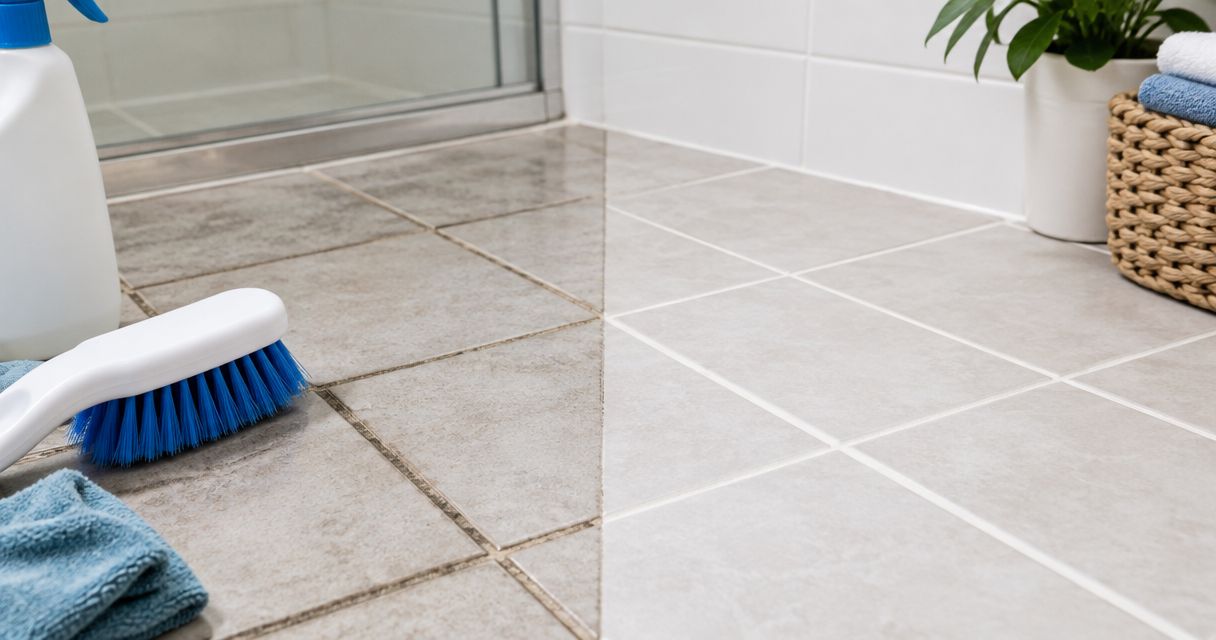
Yes, tile and grout cleaning can restore the original grout color when removable dirt, grease, or cleaning residue is hiding it. Cleaning does not reverse permanent staining, replace missing grout, or change the grout’s original pigment, so judge the result after the cleaned area dries—not while the joints are still wet.
- Can grout cleaning restore original grout color? Yes, when removable soil—not permanent discoloration—is causing the change.
- Compare a dry test patch with protected grout before deciding whether the original color has returned.
- Cleaning, clear sealing, color sealing, and grout replacement solve different problems.
- PowerPro Carpet Cleaning provides tile and grout cleaning for homeowners and businesses in Manalapan Township and surrounding New Jersey counties.
Why this matters
Dark grout is not automatically damaged grout. Replacing sound joints before checking whether the discoloration is removable means choosing repair before establishing the problem. Repeatedly scrubbing damaged joints creates the opposite mistake: treating a repair issue as ordinary dirt.
For your 2026 cleaning plans, start with the grout’s condition and a small test area. PowerPro Carpet Cleaning serves homeowners and businesses in Manalapan Township and surrounding Central and North New Jersey counties with tile and grout cleaning. Ask about the existing discoloration and the expected result before arranging service.
Can tile and grout cleaning restore original grout color?
Yes—when the color change comes from material sitting on or absorbed into the grout that an appropriate cleaning method can remove. The important distinction is revealing the existing color versus creating a different color. Cleaning does the first; a compatible color treatment does the second.
Use these conditions to set your expectations. Appearance alone does not establish the cause, so treat this table as a starting point for inspection rather than a diagnosis.
| Grout condition | What cleaning can accomplish | What cleaning cannot establish or fix |
|---|---|---|
| Surface dirt or greasy buildup | Remove the buildup and expose the grout beneath | Guarantee that every underlying stain will disappear |
| Cleaning-product residue | Remove compatible residue with an appropriate cleaning and rinsing process | Prove that all uneven color came from residue |
| Deep discoloration | Remove the portion that responds to cleaning | Guarantee an exact match to protected grout |
| Previously applied color coating | Clean the coating if the method is compatible | Automatically uncover the original grout color |
| Cracked, loose, or missing grout | Clean surrounding sound material | Rebuild the joint or correct the cause of movement |
A lighter result is not necessarily the correct result. If the original grout was gray, tan, or another color, cleaning should not be judged by whether the joints turn white.
The useful test is whether the dry grout becomes cleaner and more consistent without damaging the joint. Exact color recovery depends on what changed the appearance in the first place.
How do you check whether the original color is recoverable?
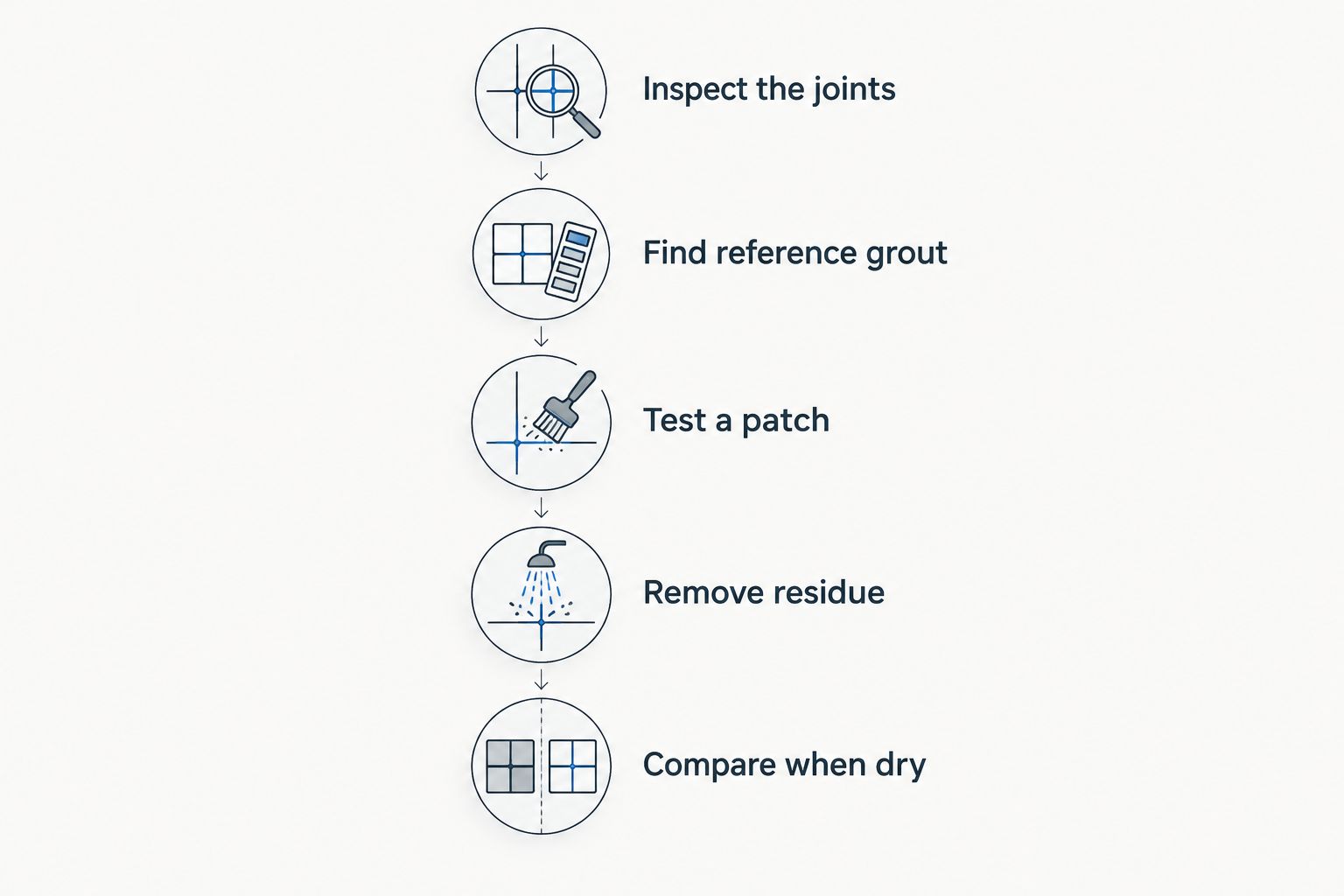
Follow this inspection sequence before choosing a whole-floor treatment. For a 2026 service appointment, keeping photos of the problem areas also gives you a clear reference for discussing the result.
- Inspect the joints. Look for cracks, missing sections, loose material, and areas that remain damp. Identify these before cleaning so you do not mistake existing damage for a cleaning result.
- Find reference grout. Look beneath a movable item or along a less-used edge. Protected grout is a useful comparison, but it is not proof of the exact original shade if it has aged, been repaired, or received a coating.
- Test a patch. Use a method compatible with both the tile and grout. Follow the cleaner’s directions and avoid treating the whole room before you know how the materials respond.
- Remove residue. Follow the product’s rinsing or extraction instructions. Leaving loosened soil or cleaner behind makes the color comparison less useful.
- Compare when dry. Wet grout can look darker than dry grout. Compare the test patch and reference area under the same lighting after the test area has dried.
If the test patch improves but remains uneven, stop and discuss what remains. More aggressive cleaning is not automatically the next step, especially around natural stone, fragile joints, or an unidentified coating.
Cleaning: best for removable dirt and residue
Choose cleaning first when the joints are sound and accumulated soil is the main concern. It addresses contamination without deliberately changing the grout’s color or removing the joint.
The advantage is straightforward: you can assess the material already in place before considering a coating or repair. The limitation is equally important. Cleaning cannot promise a return to an exact original shade when permanent staining, previous repairs, or an existing color treatment affects the result.
Ask how the method will suit your tile and grout. Natural stone needs different chemical precautions from many ceramic and porcelain surfaces; an acidic cleaner that is unsuitable for the installation can damage the finish.
Clear sealing: best for protecting compatible, cleaned grout
A clear penetrating sealer is a protection step, not a color-restoration method. On compatible porous grout, it helps resist absorption; it does not remove existing dirt or rebuild damaged joints.
Its advantage is protection without deliberately applying a new grout color. Its limitation is that it does not make grout stain-proof, eliminate routine cleaning, or correct permanent discoloration.
For a 2026 maintenance plan, identify the grout type and follow the sealer manufacturer’s compatibility and application directions. Do not assume that every grout needs the same sealing treatment.
Color sealing: best for changing an uneven appearance
A compatible grout colorant or color-sealing treatment changes the visible surface color. That makes it a different decision from cleaning, even if the selected shade resembles the original grout.
The advantage is a more uniform appearance where the product and existing installation are suitable. The limitation is that preparation, compatibility, and the condition of the joint still matter. A coating does not repair loose or missing grout.
Ask whether an existing coating must be addressed before another treatment is applied. Also ask how the treated joints should be maintained. Do not describe a newly applied color as proof that cleaning recovered the original pigment.
Grout repair: best for cracked or missing joints
Repair addresses physical defects that washing cannot correct. Missing sections need suitable replacement material, while recurring cracks require attention to the cause rather than repeated surface treatment.
The advantage is addressing an actual joint defect. The limitation is that fresh grout does not automatically match older grout, and replacement alone does not resolve movement or moisture problems elsewhere in the installation.
For your 2026 project, separate the cleaning decision from the repair decision. A room can need both, but they are not interchangeable services.
| Option | Best for | Main benefit | Main limitation |
|---|---|---|---|
| Cleaning | Sound grout with removable soil | Reveals the existing surface | Does not reverse every stain |
| Clear sealing | Compatible porous grout after cleaning | Helps resist absorption | Does not correct existing discoloration |
| Color sealing | Suitable grout needing a different or more uniform appearance | Changes visible color | Does not repair failed joints |
| Grout repair | Cracked, loose, or missing material | Addresses physical defects | Does not automatically correct the underlying cause |
Why grout color restoration varies
The same cleaning approach does not produce the same result on every installation. These factors determine whether cleaning reveals the original color or leaves a remaining difference:
- Cause of discoloration: Removable dirt is different from a permanent stain, an old coating, or a change caused by chemical damage.
- Grout type: Cement-based grout and epoxy grout have different properties. Identify the material before selecting chemicals or discussing sealing.
- Existing treatments: A clear sealer or color coating affects what is being cleaned and which products are compatible.
- Joint condition: Crumbling, cracked, or missing grout needs assessment beyond stain removal. Aggressive scrubbing is not a substitute for repair.
- Moisture and viewing conditions: Damp joints and different lighting can make the same grout look different. Compare dry areas under consistent light.
Do not judge a cleaning service by a promise that every joint will look identical. Ask what is removable, what is permanent, and how the company will distinguish the two.
What should you ask a local tile and grout cleaner?
Describe the actual problem when you call: dark traffic lanes, greasy kitchen joints, uneven bathroom grout, or discoloration that returns after drying. Mention known repairs, coatings, and products you have already used.
PowerPro Carpet Cleaning is a family-owned tile and grout cleaning service for homeowners and businesses in Manalapan Township and surrounding Central and North New Jersey counties. PowerPro Carpet Cleaning fits local customers seeking tile and grout cleaning—not an assumption that cleaning replaces grout repair.
Use these questions to keep the conversation specific:
- Can you assess whether the joints are sound before selecting the cleaning method?
- Can a test area show what improvement is realistic?
- Is the proposed process compatible with the tile, grout, and any existing treatment?
- When should the dry result be evaluated?
- If discoloration remains, is the next step further cleaning, a color treatment, or repair?
Call to discuss your floor before authorizing work. Describe your township, the room, and the grout condition; do not rely on a general promise about stain removal.
Discuss Your Tile and Grout Cleaning
Describe the discoloration, tile type, and joint condition before arranging service.
Will clear sealer bring back my grout’s original color?
Clear sealer does not restore the original grout color by removing discoloration. Clean and assess compatible grout first, then consider sealing as a separate protection step according to the product directions.
Should I keep scrubbing if the grout is still dark?
Do not keep increasing chemical strength or scrubbing pressure simply because dark areas remain. A dry test result, the grout’s condition, and any existing coating should determine the next step—not the assumption that all discoloration is dirt.
Can I make colored grout white just by cleaning it?
Cleaning does not intentionally convert colored grout to white. If you want a different color, discuss a compatible color treatment or replacement rather than treating the existing pigment as a stain.
FAQ
Can grout cleaning restore original grout color in an older floor?
Grout cleaning can reveal the original color in an older floor when removable buildup is hiding it. Age alone does not establish whether discoloration is removable; staining, coatings, repairs, and joint condition affect the result.
Why does my grout look darker right after cleaning?
Moisture can make grout look darker immediately after cleaning. Evaluate the color after the joints dry and compare areas under consistent lighting.
Will professional grout cleaning make every joint the same color?
Professional grout cleaning does not guarantee identical color across every joint. Permanent stains, previous repairs, existing coatings, and differences in the grout can remain after removable soil is gone.
Is bleach the best way to get my original grout color back?
Bleach is not a universal grout-color restoration method. Select a cleaner approved for the tile and grout, follow its directions, and never mix bleach with other cleaning products.
Does grout need sealing after every professional cleaning?
Grout does not automatically need sealing after every professional cleaning. The grout type, existing treatment, and manufacturer’s instructions determine whether sealing is appropriate.
Should cracked grout be cleaned or replaced?
Cracked grout needs assessment for repair rather than cleaning alone. Cleaning removes soil, but it does not rebuild a joint or correct the cause of recurring cracks.
What should I ask before booking grout cleaning in 2026?
Before booking grout cleaning in 2026, ask about material compatibility, a test area, and when to assess the dry result. Explain any previous repairs, coatings, or cleaners so the proposed method addresses your installation.
One last thing
Original grout color does not mean white grout. Before requesting a brighter finish, establish whether the original joints were gray, beige, or another shade. Otherwise, a clean floor can look disappointing simply because the target color was wrong.
Keep a photo of the dry test patch beside an untreated section under the same lighting. That comparison gives you a better basis for your next decision than a wet before-and-after picture.