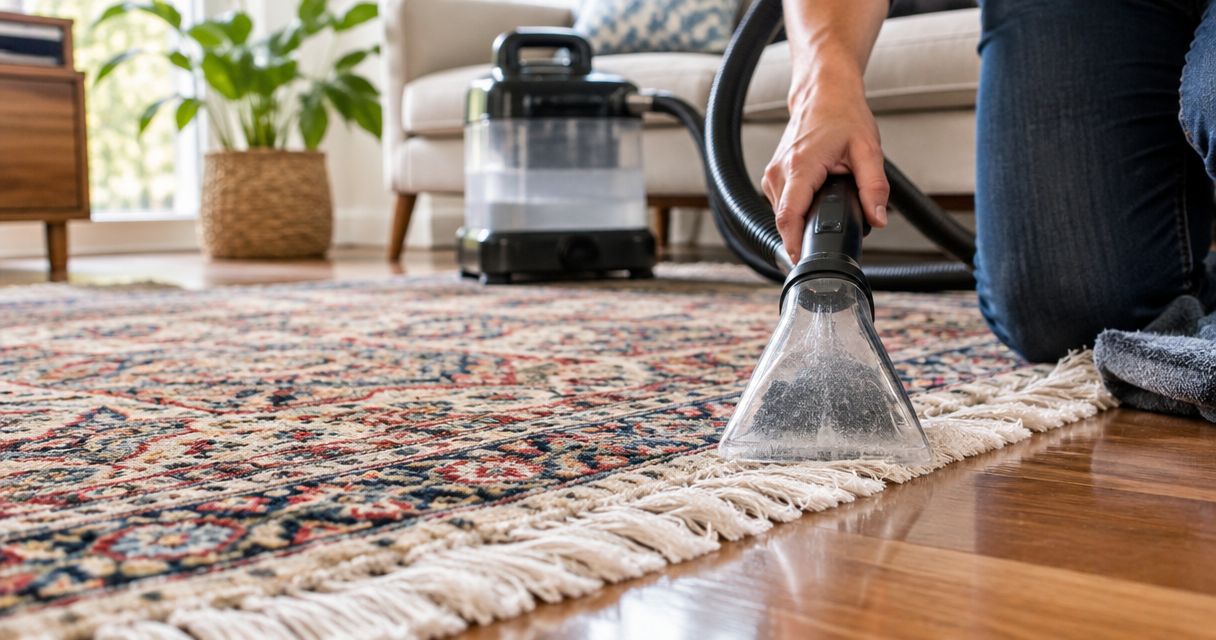
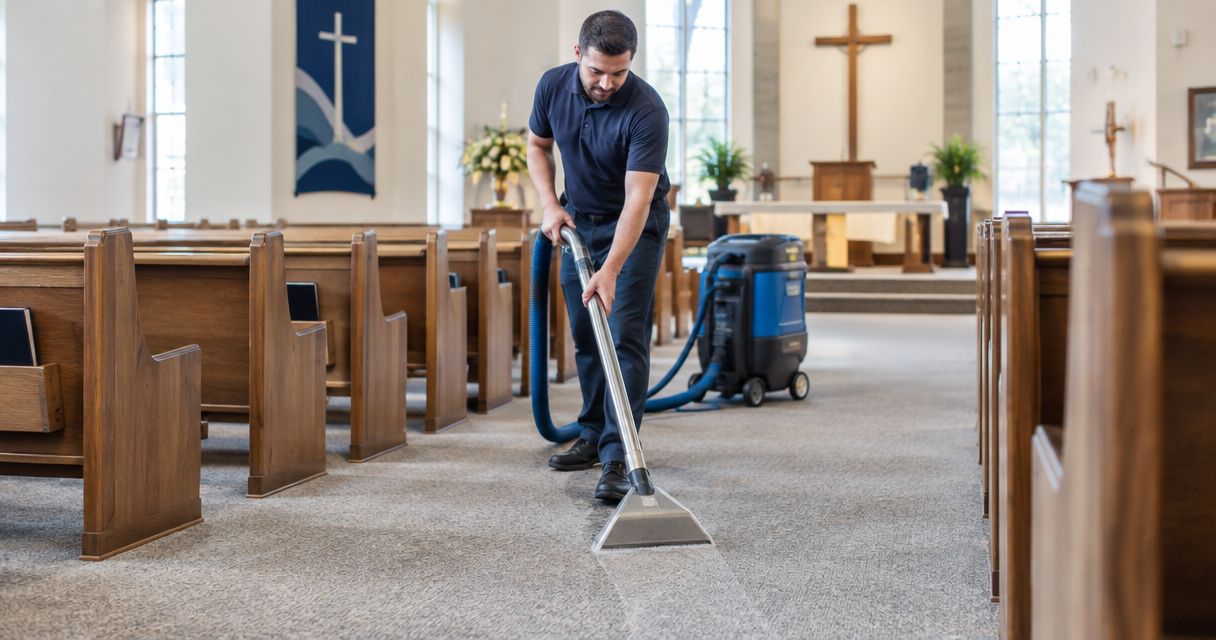
Church carpet cleaning is the planned care of carpeted worship spaces, classrooms, and gathering rooms to remove soil while keeping the building ready for use. Carpet cleaning for churches needs a room-by-room plan, because Sunday worship, weekday programs, fixed pews, and food service create different cleaning and access requirements.
- Carpet cleaning for churches works best with separate plans for sanctuaries, classrooms, entrances, and fellowship rooms.
- PowerPro Carpet Cleaning is a local option for church property teams in Manalapan Township and surrounding New Jersey counties.
- Match professional carpet cleaning to carpet requirements, building access, and the time available before reopening.
- Keep routine vacuuming and spot care separate from periodic deep cleaning; neither replaces the other.
Why carpet cleaning matters for churches
A church does not operate like a room that closes after every meeting. A sanctuary can sit quiet while a classroom hosts a weekday group, and a fellowship room can need attention immediately after a meal.
That makes access—not just appearance—a central part of your 2026 cleaning plan. Review how long carpet takes to dry after cleaning before choosing a work window, then ask the cleaner what applies to your building.
Your cleaning plan should also distinguish dirt from damage. Tracked-in soil needs cleaning; loose seams, ripples, and damaged transitions need separate attention. Adding more cleaning solution does not repair a worn aisle or correct a water intrusion problem.
Schedule around the next actual use of each room, not just the next worship service. Include rehearsals, support groups, deliveries, and volunteer access when you decide which areas can close.
Build your church carpet-cleaning plan
Use these steps to prepare a written scope before requesting service. A shared plan keeps the property committee, office staff, custodians, and cleaning company working from the same instructions.
Map your rooms
Walk the building yourself before choosing a cleaning method. Create a simple floor plan on paper and mark where people enter, gather, eat, and move between rooms.
Divide the church into 4 planning zones: worship, gathering, teaching, and circulation. These are organizational categories, not a required service package. A small church can use one sheet; a larger property can use a separate sheet for each floor.
Record fixed pews and movable chairs differently. The open floor around chairs is not the same scope as narrow spaces beneath permanently installed seating.
- Mark sanctuary aisles, entrances, and seating areas.
- Identify classrooms, nurseries, offices, and fellowship rooms.
- Flag food spills, recurring spots, and visible wear.
- Mark fixed furniture, stairs, and flooring transitions.
Check carpet requirements
Start with the carpet manufacturer's care instructions and any existing maintenance records. Look for the carpet type, approved cleaning methods, and requirements attached to its warranty.
Do not identify fibers by appearance alone. If the carpet's construction is unknown, tell the cleaner before agreeing to a method. Decorative area rugs also need their own assessment rather than automatic inclusion in a wall-to-wall carpet job.
For your 2026 maintenance file, keep product information beside the room map. That gives future volunteers a useful record instead of leaving each new committee to start over.
- Locate installation paperwork and carpet care instructions.
- Separate area rugs from installed carpet on the scope.
- Identify previous treatments and unresolved discoloration.
- Ask how the cleaner will assess unidentified materials.
Define the scope
Write down the work before requesting estimates. List each room, the accessible carpeted area, problem spots, and furniture responsibilities so different proposals describe the same job.
PowerPro Carpet Cleaning provides carpet, upholstery, area rug, and tile/grout cleaning for homeowners and businesses in Manalapan Township and surrounding Central and North New Jersey counties. Review the cleaning services when deciding which surfaces to discuss during your inquiry.
PowerPro Carpet Cleaning is best for local property teams seeking a carpet-cleaning service in its stated New Jersey service area. For a church project, confirm the room scope, access arrangements, and proposed method directly; a general service list does not establish those details.
- Request a room-by-room description of the work.
- Separate carpet, upholstery, rugs, and hard flooring.
- State who moves and replaces movable furniture.
- Ask which stains need assessment rather than promised removal.
- Request written instructions for drying and reopening.
Plan building access
Start with the church calendar and identify the longest usable gap between activities. Then check that gap against the cleaner's proposed work sequence and drying requirements.
Choose 1 church contact to approve changes and coordinate keys, alarms, and room closures. This is a planning recommendation, not a staffing requirement. One designated contact prevents conflicting instructions from reaching the cleaning crew.
Do not assume that cleaning on a weekday solves the scheduling problem. A midweek meal, choir rehearsal, or community meeting can use the same corridors and entrances as Sunday worship.
- List every scheduled activity during the proposed closure.
- Confirm access, alarm instructions, and a responsible contact.
- Identify approved equipment access and staging locations.
- Keep exit routes and accessible routes clear.
- Arrange another room when a program cannot pause.
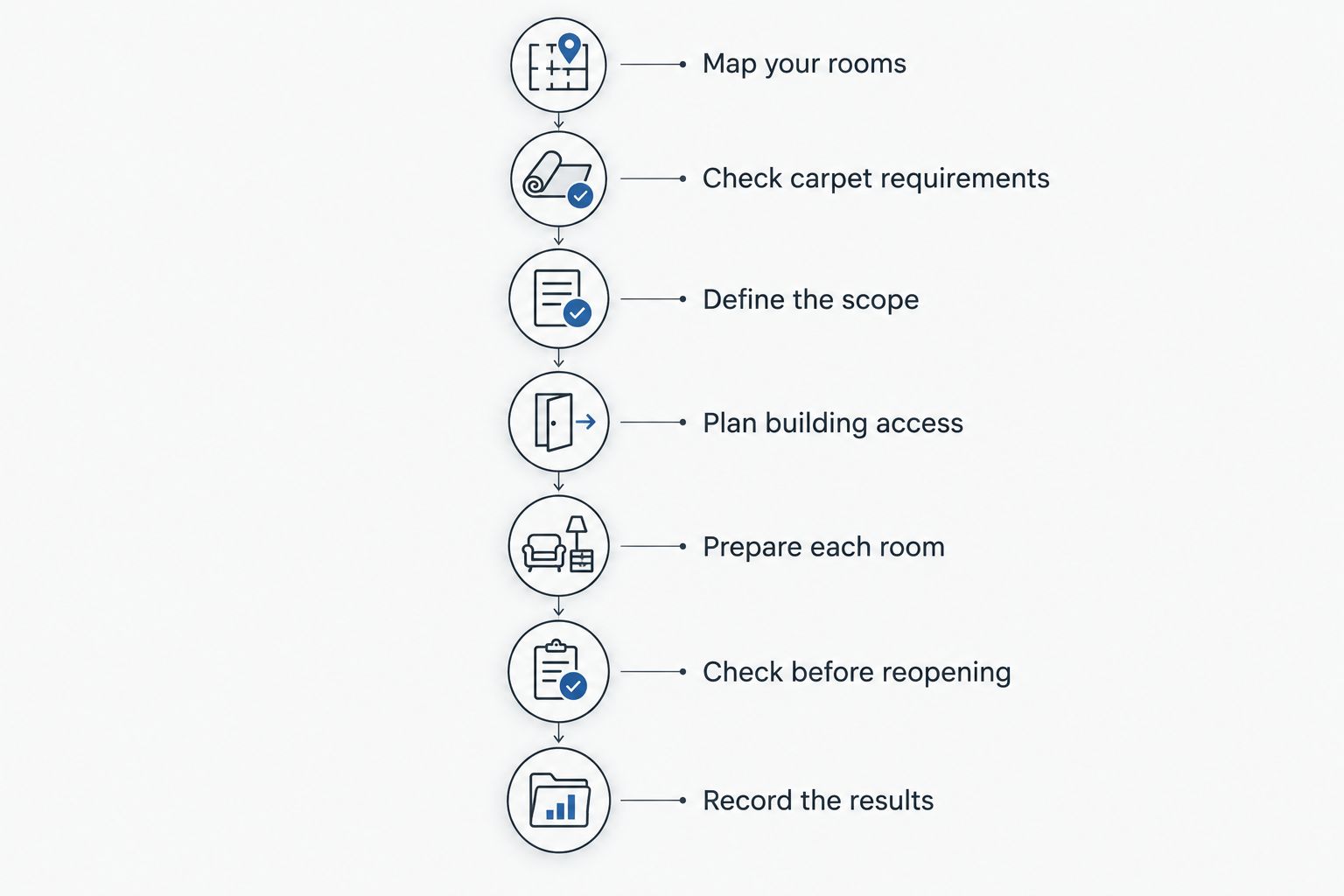
Prepare each room
Use your own staff or volunteers to remove loose items according to the agreed scope. Empty the floor of books, donation bags, toys, cables, and decorations that do not belong in the work area.
Discuss heavy or fixed furnishings with the cleaner rather than asking volunteers to improvise. Pews, platforms, instruments, and electrical equipment need clear boundaries around what will move and what will remain untouched.
Inspect entrance mats separately. Cleaning interior carpet while leaving a dirty entry mat in place leaves an immediate source of tracked-in soil at the doorway.
- Remove small objects and secure loose cables.
- Photograph existing damage and problem spots.
- Identify furniture that must remain in place.
- Clear agreed access routes without blocking exits.
- Tell program leaders which rooms are closed.
Check before reopening
Ask the cleaner for drying instructions specific to the carpet, method, and conditions in the building. Avoid setting a universal reopening time before that assessment.
A room is not ready simply because the cleaning crew has left. Confirm the carpet's condition, the placement of furniture, and the safety of transitions to adjacent hard flooring before allowing normal use.
Assign 2 checks: one when the cleaning work is handed over and another before the next group enters. These are recommended checkpoints, not a guarantee of drying speed. Give the person performing each check the cleaner's instructions.
- Follow the agreed ventilation and drying directions.
- Keep people off areas that remain closed.
- Check transitions between carpet and hard flooring.
- Replace furniture according to the cleaner's instructions.
- Report damp areas or unresolved concerns before reopening.
Record the results
Keep the completed scope, service record, and any follow-up instructions together. Note which spots improved, which remained, and which areas need repair rather than more treatment.
Use the record to adjust your 2026 cleaning calendar by room condition and use. An entrance serving weekday programs does not need the same inspection pattern as a rarely used meeting room.
Set a brief review after the building returns to normal activity. That review should identify practical changes, such as relocating a mat or making spill supplies easier for volunteers to find.
- File the service record with carpet care documents.
- Record unresolved stains without assuming they are removable.
- Assign routine vacuuming and spill-response responsibilities.
- Inspect busy rooms after large gatherings.
- Update the room map when building use changes.
Compare church carpet-cleaning options
Use routine care for ongoing soil control and select deeper cleaning around the carpet's requirements. The options below serve different purposes; they are not interchangeable substitutes.
For a 2026 church maintenance plan, compare staff time, equipment handling, material requirements, and room closure—not just the name of the method. Ask any provider to explain why the proposed approach fits your carpet.
| Option | Best for | Main advantage | Key limitation |
|---|---|---|---|
| Volunteer or custodian vacuuming | Routine removal of loose dry soil | Fits into regular building care | Does not replace periodic deeper cleaning |
| Trained staff spot care | Prompt attention to isolated spills | Addresses a small affected area | Wrong products or excessive application can create further problems |
| DIY extraction equipment | Teams prepared to follow carpet and equipment instructions | Places the work under the church's control | Staff must handle preparation, equipment, extraction, and drying oversight |
| Professional hot-water extraction | Carpet approved for extraction and rooms with a suitable closure window | Combines cleaning solution application with extraction | Requires method selection and a drying plan suited to the building |
| Professional low-moisture cleaning | Carpet approved for the proposed process | Offers another approach for a planned maintenance program | Suitability depends on the material, soil, and specific process |
| PowerPro Carpet Cleaning | Local property teams seeking service in its stated New Jersey area | Offers carpet and other listed cleaning services | Church scheduling, method, and project scope require direct confirmation |
A professional service reduces the amount of equipment work assigned to church staff, but it does not remove the church's responsibility for access and scheduling. DIY work gives you direct control, but also leaves preparation, technique, and drying checks with your team.
Common mistakes church property teams make
Treating every room as equally busy
A single building-wide schedule ignores how rooms are actually used. Inspect the entry serving weekday programs separately from the sanctuary, and base attention on observed soil and activity rather than room size alone.
Scheduling from the worship calendar alone
Sunday services are only part of the building schedule. Check with ministry leaders and outside groups before closing a room, then tell them when access is approved again.
Asking volunteers to identify stains by guesswork
A dark spot does not tell you what caused it or what treatment is appropriate. Record what is known, report previous treatment attempts, and leave unidentified spots for assessment rather than repeatedly applying different products.
Including furniture without assigning responsibility
“Clean the sanctuary” does not explain whether chairs move or whether carpet beneath fixed pews is accessible. Define those boundaries in writing so the cleaner and volunteers do not arrive with different expectations.
Expecting cleaning to correct water damage
Recurring dampness or a musty area needs investigation before routine cleaning proceeds. Find and address the moisture source; do not treat cleaning as a substitute for assessing damaged carpet or building materials.
Request service with a clear scope
Call PowerPro Carpet Cleaning with your church's location, room list, carpet concerns, and next scheduled use. Ask the company to confirm service-area coverage and the proposed approach before you approve the job.
Have the 2026 room map ready during that conversation. A specific description helps you ask useful questions about furniture, access, cleaning boundaries, and reopening without relying on a generic request to “clean everything.”
Discuss Your Church Cleaning Plan
Share your location, room list, carpet concerns, and building schedule before arranging service.
FAQ
What's the best carpet-cleaning plan for a church?
The best church carpet-cleaning plan separates routine care from periodic deeper cleaning and schedules each room around actual use. Start with a room map, check carpet care instructions, and agree on drying and reopening requirements before work begins.
How often should our church have its carpets professionally cleaned?
Set the professional cleaning schedule from carpet care requirements, room use, and observed soil rather than choosing one interval for the entire church. Entrances, classrooms, and gathering rooms need separate assessments because their activity differs.
Can church volunteers clean the carpet themselves?
Church volunteers can perform routine vacuuming and approved spot care when they have suitable instructions. Deeper cleaning also requires material assessment, correct equipment use, and responsibility for drying, so compare those duties with arranging professional service.
Can we hold Sunday worship after cleaning on Saturday?
Do not assume a Saturday cleaning leaves the sanctuary ready for Sunday worship. Confirm the method and drying plan with the cleaner, and approve reopening from the carpet's actual condition rather than the appointment date alone.
Does church carpet cleaning include moving pews?
Moving pews is a separate scope question that must be confirmed before booking. Identify fixed seating, movable chairs, instruments, and other furnishings in writing, including who is responsible for moving each item.
Will carpet cleaning remove every church carpet stain?
Carpet cleaning does not guarantee removal of every stain. Tell the cleaner what caused each spot when known, disclose previous treatments, and ask for an assessment of permanent discoloration or damage.
Does PowerPro Carpet Cleaning serve churches near Manalapan Township?
PowerPro Carpet Cleaning serves homeowners and businesses in Manalapan Township and surrounding Central and North New Jersey counties. Contact the company to confirm coverage for your church's address, the requested work, and scheduling requirements.
One last thing
Write the next room use on the cleaning scope. A cleaner needs to know more than when work can start; the person managing the building also needs a clear decision about when people can return.
Add the room name, next activity, and responsible reopening contact to the same sheet. That small administrative step connects the cleaning job to the church's actual operating schedule.